“Sod the wine, I want to suck on the writing. This man White is an instinctive writer, bloody rare to find one who actually pulls it off, as in still gets a meaning across with concision. Sharp arbitrage of speed and risk, closest thing I can think of to Cicero’s ‘motus continuum animi.’

Probably takes a drink or two to connect like that: he literally paints his senses on the page.”


DBC Pierre (Vernon God Little, Ludmila’s Broken English, Lights Out In Wonderland ... Winner: Booker prize; Whitbread prize; Bollinger Wodehouse Everyman prize; James Joyce Award from the Literary & Historical Society of University College Dublin)


.

.

.

.

05 April 2018

EXPORT: RUSTON'S APRIL FOOL'S DAY EDICT

 ,
Fit and proper people: big Oz wine corps to preselect aspirant exporters
by PHILIP WHITE


April Fool's Day was a strange date for Riverland Senator Anne Ruston to announce that "New regulations for grape products coming into effect today will provide greater protection for Australian wine brands and the reputation of Australian wine exports." 

In her role as Assistant Minister for Agriculture and Water Resources, (read Murray-Darling/Riverland) the surviving former portfolio offsider of the disgraced former Prime Minister Barnaby Joyce spoke on behalf of the Australian Grape and Wine Authority, which trades as Wine Australia. 

LNP Riverland politicians Tim Whetstone and Anne Ruston with Deputy Prime Minister Barnaby Joyce (centre) announcing $50 million in government grants to seelect wineries last year ... after a string of scandals Joyce has since been forced to resign in disgrace; since the recent state election, Whetstone is South Australia's new Minister for Agriculture

"Minister Ruston said Wine Australia now had the capacity to assess whether an exporter was a 'fit and proper person'," the statement explains. 

For some reason the declaration reminds me of a "Stop The Boats!" rant from the extreme right-wing Minister for Home Affairs Peter Dutton ...

"There will always be unscrupulous people seeking to make easy money from reputations carefully established and built by legitimate Australian wine producers and exporters ... Wine Australia can now ensure the bona fides of potential and existing exporters before issuing export approvals."  

This peak industry council is a Commonwealth statutory authority governed according to the Australian Grape and Wine Authority Act 2013. It is funded by winemakers but annually subsidised to the tune of about $13 million by the taxpayer. Its board members are nominated by the wine industry but must be approved by the Minister. It is responsible for doshing out the $50 million of further taxpayer-funded direct cash grants to wineries announced last year at Penfolds Grange by Ruston and Joyce

Tom and Anne Ruston on the campaign trail with dumped LNP Prime Minister Tony Abbott


While the senator’s promise is encouraging for drinkers outside of Australia, the authority’s past form is worth examining.  

In May 2000 I became aware that Californians Haydn Wildon and Nicole Haller, work-experience students from the winemaking faculty at the University of Davis, had warned their classmates at home that the big Riverland exporting winery, Kingston Estate, added silver nitrate to wine to eliminate the smell of hydrogen sulphide, had used liquid red tannin to add colour to red wines, and fermented sultana juice on red skins from Cabernet sauvignon to make red wine. They also mentioned sulphuric acid and pure ethanol additions. 

I first rang Bill Moularadellis, the chief winemaker and managing director of Kingston Estate. He said he had not heard of the accusations and seemed highly concerned. Next was Sam Tolley, then general manager of the Australian Wine and Brandy Corporation, the body since renamed Wine Australia, who gave a similar response. 

I advised both gentlemen that I would be writing of this in The Advertiser; Tolley sent the inspectors in and withdrew Kingston Estate's export license. 

Moularadellis was fully co-operative, saying he was keen to protect his winery’s international reputation and that of the Australian wine industry. 

In his first announcement, Tolley stated there was no risk to public health and although the issue was of a "technical nature", he said, "nevertheless, we take any allegations very seriously. We need to act quickly in circumstances such as this to ensure that any products which are exported are of the highest quality."

The author addressing the Wine Press Club at the National Wine Centre in 2010. Bill Moularadelis, left, Treasury Wine Estates chief purchasing officer Stuart McNab over my shoulder and Empire Liquor wholesaler Brenton Quirini ... photo Leo Davis

While that news shlooshed around the world and huge British supermarket chains like Tesco and Waitrose immediately removed Kingston Estate from their shelves, back in Australia the investigation seemed mainly to focus on the silver nitrate issue. 

Hughes Public Relations advised Moularadelis. In their own words, their goals were:  

1 Minimise negative impacts on domestic and export sales 
2 Protect the integrity of Kingston Estate Wines’ brand and products 
3 Minimise competitor criticism 
4 Manage media liaison and minimise media criticism and speculation 
5 Limit the geographical spread of media coverage 
6 Protect the integrity of the Australian wine industry in world markets 

"Within a week of the story breaking," the Hughes summary reported, "Kingston Estate's export licence was re-instated, but the prosecution went ahead and in January 2001 the company was fined $4,000 in the Adelaide Magistrate’s Court for using illegal additives in an export product."  

The maximum fine for such crime was $10,000. 

In an interview for the State Library's Oral History Collection, Moularedellis told Rob Linn this had been the most challenging period of his life. 

"We used silver nitrate in our wine and we shouldn't have," he admitted. 

"Had we not used that, there would not have been a problem. 

"We had a huge media frenzy to deal with because we were seen as a major exporter that had potentially compromised this whole Australian wine industry success story, and so all the checks and balances the industry had put into place to protect the industry for things like that came into being. We had our export licences suspended temporarily. You know, at the end of the day we were in crisis, and people had a crisis with our wines, because we were seen to have done something wrong." 

There was a mad scramble around the wine refineries and ivy-hung nuts-and-berries joints alike: a sweaty clean-up of those sacks and drums of reagents that tend to stack up in corners. 

"The most regrettable cost for me," Moularadellis said, "is that I gave some of the critics of the Riverland, by that action, the credibility to be able to say that we told you so. One of the lasting issues has been the fact that it gave credibility to those people that were critical of the Riverland, and it was a Riverland thing."  

Murray Tyrrell at the Last Bottle Club with former LNP Prime Minister Malcolm Fraser in the early 1980s


The investigation and conviction rigmarole pretty much followed the late ’80s bust of Hunter legend Murray Tyrrell for adding another chemical, sorbitol, to Tyrrell’s wines, including those he'd bought from the riverlands. 

Before running that story, I rang the Wine and Brandy Corporation to report the allegations and asked what it’d do about it. In essence, they proceeded to test the wines, made the charge, punished the lawbreaker and used their actions to prove to their export markets that their policing of illegal activities was efficient, effective and protective of the rest of the industry.  

But the corporation didn’t start it, I did. 

In detail, the story was much more rococo. After discussions with truckies in the Truro top pub, where I lived north of the Barossa, I became aware of a great deal of apple juice being delivered to some very famous wineries, none of which made cider. 

The rumours suggested that like the Kiwi fruit, one could make a presentable Sauvignon blanc from it with a bit of sophistry and water. Having taken the advice of industry leader Len Evans and spent all their money covering Australia with too much Chardonnay, winemakers were in a flat panic that this fad would quickly be replaced by Sauvignon blanc, which they didn’t have. 


One honest fellow showed me his log book, listing what he’d delivered and to whom. I called George Mackie, then boss of the Wine and Brandy Corporation, to ask what he would do about it. The wine police went on a buying spree around the liquor stores and tested a great deal of wine for sorbitol, a chemical that occurs in tiny amounts in apples but not grapes. 

A non-intoxicating alcohol, this wetting agent is used in tobacco, ink and enemas, but is not a permitted wine additive. When they discovered it in Tyrrell’s wines, the authorities proceeded against the company. Tyrrell, who was on the government committee that managed the list of permitted additives, pleaded guilty, was fined and ordered to withdraw from the international marketplace all the offending wine and destroy it. 

He then sued me for defamation for my reportage in The Bulletin, along with Kerry Packer as publisher. Because I was not on staff, Packer left me to mount my own legal defence. After years of sooling his silks and whatnot at me, Tyrrell lost. His reputation, particularly in New South Wales, stayed pretty much intact: rogue maybe, but a popular one, and a patriarch. 

I always felt Tyrrell, a friend of Mackie's, was a convenient scapegoat for the entire industry. No winery was charged for apple juice substitution. 

Stressed beyond belief, poor Mackie died of a heart attack.

Fit and proper people. 

So while we welcome Senator Ruston’s April Fool’s Day statement, I’m keen to see whether the old boys at Wine Australia are simply scaring new Chinese investors out of exporting dodgy Ozplonk. 

It’d be too sicko bogan to discover it’s just a convenient appeasement for the uncaught when the Senator promises that “the new regulations will also cut red tape for exporters by halving export certificate notification periods and reducing timeframes from order to export”.

04 April 2018

SAUSAGE ROLLS AT MYPONGA

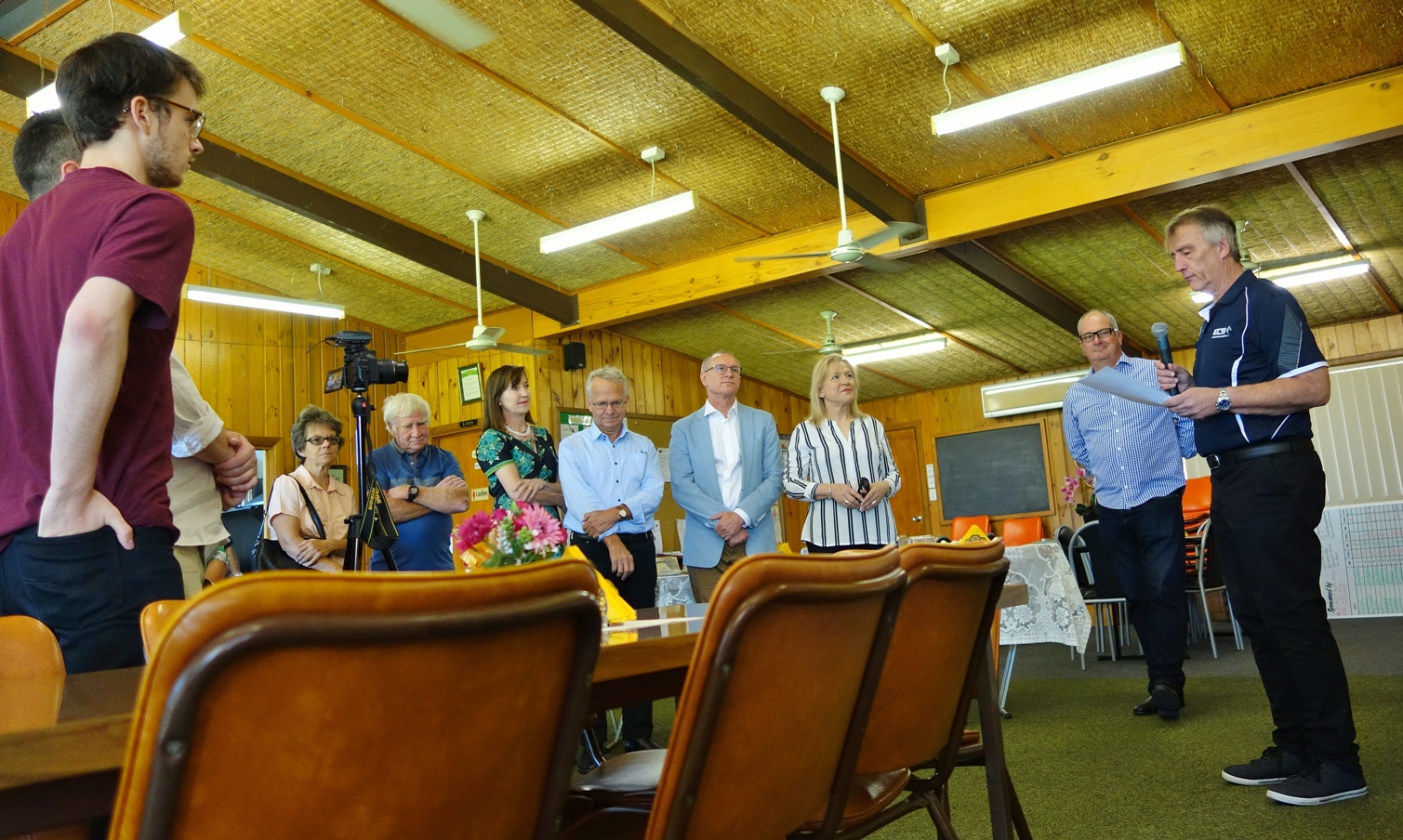
Twas a lovely sunny morning at the Fleurieu Peninsula town of Myponga when Peter Verkerk, the Electoral Commission's returning officer for the South Australian parliamentary seat of Mawson, finally declared the poll in the Bowls Club.

We could smell the sausage rolls from the car park.

Former Premier Jay Weatherill was there, looking remarkably refreshed and relaxed since his Labor Party lost (he held his seat), along with former Minister Kyam Maher, who will now lead the party in the Legislative Council, and new Labor leader, Peter Malinauskas. 

That's Verkerk making the announcement, right, with former minister Leon Bignell, with failed SA Best candidate Hazel Wainwright and Weatherill to his right.

As you can see in the deadly simplicity of the form, the long vintage-time campaign resulted in a very narrow victory for "Biggles", who is a stalwart supporter of the wine industry. Much of the traditionally conservative Fleurieu Peninsula vignoble, all of Kangaroo Island and McLaren Vale now lie within the newly-drawn Mawson boundary.

"When the new boundaries came through Jay looked at me in Cabinet and said 'This looks pretty shit for you Biggles'," Bignell said in his acceptance speech.

"But I had a look at the new redistributed Mawson boundaries," he continued, "and I said 'Hang on, it looks like I've got eight new pubs, about 21 bakeries, a distillery, three breweries, and an island', so with a whole bunch of friends and family I set out to retain the seat of Mawson."

Which, against all the odds, he has done.

Reflecting on the public forum we'd had in the McLaren Vale Bocce Club, he said "McLaren Vale's got a lot of different groups and they don't necessarily come together under the one roof all that often ... and what happened that night united people who came together and it was terrific to have those discussions and hear from people as to what they thought."

Biggles promises to listen even harder as he sets out to represent his new electorate from the opposition benches. Time for more unity and public discussion methinks. Democracy doesn't come cheap.

And more of those knockout Myponga sausage rolls, please!

01 April 2018

TASTING ON A ROOT DAY

Yesterday I went with some friends to taste the Yangarra wines, which are made biodynamically by my landlord, Peter Fraser. They all seemed strangely narrow and tannic. Suspicious, and somewhat rattled,  I consulted the Biodynamic Calendar, which showed it was a "root day". Reality or bullshit? 

I quite deliberately avoid keeping a copy of the calendar close handy, but over the years I occasionally find myself doubting my organoleptic capacities - a scary feeling - so I consult the calendar. They're almost invariably root days. Russell Jackson caught this image of the moment of enlightenment and relief - yours truly with Cynthia Ganesharajah.

31 March 2018

WINE GLASS DIPLOMACY IN BEIJING

Wine marketing 1: Kim Jong Un, the North Korean leader, and his Chinese counterpart Xi Jinping ... the socio-economic implications of the stemware: consider and discuss.

30 March 2018

A NIGHT WITH THE WHITES AT MITCHELLS'

.
Marine musical motorsport thrash at the Mitchell family's Code White
by PHILIP WHITE

Mitchell Clare Valley Semillon 2016  
($24; 12.2% alcohol; screw cap) 

If you'd preserved some fetta in light, acidic olive oil with some fresh lemon verbena tips and fine-sliced - like translucent - rinds of kaffir and finger limes you'd be getting close to the slightly cheesy wafts of this baby. 

Burlap sack. Isovaleric acid. Tarragon. Lemon balm. Wheaten hay. Slender fatty acids. Butyric acid. 

Such a crunchy sweetheart looks a slightly awkward youth of a wine now, but if you got close in there through the hair it could be Joey Ramone, he who showed little sign of knowing nor revealing any normal measure of age from birth to death. 

And out of everybody, you probly wouldna picked Joey to be lemony. 

But when one delves, this bowl of cheeky flavour devoid of excess cushioning and anæsthetising ethanol is only 12.3 alcohols. So it's actually almost ethereally light and disappearing if you're willing to just dance and shut up and not be such a forensically obsessive bore sitting there with all those goddam books you pretend to read. 

Music to me.

On your feet! Hey. Ho. Let's go. 

Jump a decade to the 2006 release (13%; screw cap) which is no longer available but is a fair guide to how that '16 will go. Same band, bleached by time. All those things have been in the sun. Rockaway Beach? Spin me out. 

But it's more along the lines of somebody you'd run into with sand dropping off their plastic on the bar at Olaf the Owner's Bombora Café on Cockle Beach at Goolwa. 

Somebody the colour of bleached coffee flashing a million bucks of teeth; Ligurian honey in the boardwax. Voombochoof! 

I'm really glad that the Mitchells persist with their take on this forgotten slice of old Clare. It'd go real good with Joey's favourite Kinpira Gobo. Or Poulet au riz à la Provençale - chicken pilaf - as prescribed by Richard Olney in his vital Provence the Beautiful Cookbook

Joey Ramone sitting down with Richard Olney at Hasaki on East Ninth Street, now there's a notion ... Older the younger, as it were ... We'd need Norman Rockwell to paint it. 

Mitchell Watervale Clare Valley Riesling 2017 ($24; 13% alcohol; screw cap) 

We're strapped into an even stiffer racing frame in the Rieslings. Double the torsional strength, half the weight. Closer to the ground. If the windows went down you could scrape your knuckles on the bitumen. The young 'un has all the lemon and citrus of the Semis. A bit of it seems slightly toasted like as if it's just done three hot laps but it's wrapped down now securely in damp Watervale chalk and everyone's standing around looking amazed and talking quiet. It prickles and flares the nostrils. It's like cranking King Gizzard & the Lizard Wizard in a Lotus Europa with the Cozzy 1600 Mk.XIII dry sump on a Hewland FT200 for two hours through the hills on real good tyres before lunch. One needs to turn it up. 

As for the older McNicol Clare Valley Riesling 2009 ($35; 13.5% alcohol; screw cap)? Get down. Not a minute older for most of us to sniff, just different. 

It gets near that perfect dunal fragrance that many romantics call ozone but which is actually dimethyl suphide, the breezy whiff of an healthy fizzing ocean full of dead and deadly-fresh phytoplankton. 

That's just the leading edge. Get in deeper and it smells like fresh enoki spliced with the minor aromatic gene from the Curaçao orange grown in talc. It has a similar comforting fluff in its swallow: it is never hard nor citric/metallic like much Clare Rizza. It is too soft for fish and chips. 

Rather, cut yourself a fat slice of crusty bread and spread it with your favourite butter or a better one. Fillet your King George whiting, cook it for a hot buttery flash on the skin of its back, spread it on your bread, squeeze a drop or two of lemon on it, grind fresh pale pepper on there and now try not to guts everything down at once.

28 March 2018

WATCH THAT WATER IN YOUR WINE

rejected, but still full of sugar: mouldy, raisined, machine-harvested fruit in 2011

Is this the Age of the Snake? Typical rort rumours arise as law relaxes
by PHILIP WHITE

As the mists of Easter roll in over the tail of vintage 2018, and the fruit still hanging chugs up through the Baumé - sixteen, seventeen, more - the tanks of many Australian winemakers contain a new addition they're not supposed to be fluent in: water. 

The old "Black Snake" - the water hose - was a long-time friend of winemakers keen to get their strong wines back under control. A few minutes of the rainwater hose in the fresh must could present a table beverage more along the lines of what was traditionally acceptable in the alcohol division. Like wine of 13.5 to 14 per cent ethanol. 

But it was illegal to add water. 

Until February 9th this year, that is, when the Australian New Zealand Food Standards Code was altered after persistent lobbying by The Winemakers’ Federation of Australia and the Australian Grape and Wine Authority. 

Of course there's no need to add water if you pick good fruit at the right time! 

Now, providing that "the amount added being the very minimum required to achieve the desired effect," the new code "expressly permits the limited addition of water to high sugar must and juice to reduce the chance of problems arising during fermentation ... The amendment establishes that water may be added to grape juice or must to reduce the sugar level of the juice or must to a minimum of 13.5 degrees Baumé." 

All good so far. Many winemaking countries we compete with for international shelf space had permitted the practise since Jesus made his amarone at the wedding at Qana. 

The Australian industry bodies quite rightly sought a flatter playing field. Many observers, like the writer, and wine operatives of all sorts welcomed what seemed to be a logical and sensible move. 

To lever their argument into legislation, the proponents had eventually used Global Warming as their fulcrum: recent changes to vintage weather often meant harvesters, whether human or mechanical, were simply too scarce when heatwaves ripened the crop at an unseemly, inconvenient pace and everybody struggled to pick their grapes in a reasonable condition.  Simultæneously.
"Continuing to tolerate this lack of a level playing field is difficult to defend," the lobbyists had argued, when "the ability to add judicious quantities of water has no adverse effects on human health (in fact, may even provide health benefits); involves no consumer deception; maintains wine authenticity by ensuring the product’s characteristic features arise from the harvested grapes; takes into account particular climatic and other production conditions; is based on the reasonable practical need to enhance the organoleptic qualities and consumer acceptance of the wine and ensures the addition is limited to the minimum necessary to achieve the desired objective." 

The change was announced with the back-up of the excellent research paper of University of Adelaide PhD candidate Olaf Schelezki, which showed the organoleptic changes to such wine were not only minor, but could be advantageous to the drinker. Such wine, well-made, could offer a safer health outcome with a deeper organoleptic/gastronomic satisfaction. 

All neat and tidy. Fewer headaches in the pipeline. You little trimmer! 

Since then, we've seen a harvest that started with a series of heatwaves, putting on early ripeness, followed by patterns of cool moist weather, mercifully eased by drying breezes. 

This dried the canopies and helped the berries get on with their raisining.  

Across most of the state, wineries have been fairly full, but apart from that fast start we've not had the panic seen in some other recent years. 

So why is the rumour machine full of grumbles about big companies deliberately letting a lot of fruit hang well into the sixteens and beyond? 

They wouldn't, would they? 

You bet they would. 

The law now provides an incentive for bullying buyers to delay harvest a week or two while the sugars go up, the acids fall and the berries raisin and shrivel. And goodness me! Look what happens: the tonnages shrivel, too! 

To decrease their shareholders' exposure to the wiles of nature and industry, the current accounting fashion has big companies sub-contracting not only their grapegrowing, but increasingly, their actual base winemaking. They buy bulk, sometimes made to their recipe.

There's a very frigging big temptation here whoever makes the call: let the crop concentrate in sugar, fall in tonnage, and cost a lot less to purchase. 

Pick it at sixteen or seventeen after it's shed a third of its original crop weight, screw the grower, and to make up the loss of volume, poke the old Black Snake in the hopper. With impunity. 

You can add all the other bits and pieces to dress it up later: acid, enzymes, colour, tannin, aromatic yeasts, wood chips ... the controlling legislation doesn't list prohibited ingredients, but instead offers a menu of stuff the manufacturer can lawfully use. You should read it here.

Introduced to make life easier for responsible producers caught in an unforseen vintage trap, this new law has opened the floodgate for a wave of change too few saw coming.  

Not just change to the actual practise of business - there's a big opportunity here for the contract lawyers - but a change to wine style and flavour that may not be all good for all concerned.

Business grows precarious when the growing and manufacture of wine gets this close to the old battle to please the drinker, but only just enough to keep the shareholder fat. 

In the world of haute cuisine, through luxury goods and other unnecessary commodities,  such polarising of primary producer and profit-taker is always destructive. 

Prime quality comes first from the sky and the ground, not the refinery. 

If you seek to hold the respect of your customer, you nurture your grower, not the water company.  

At least the freshly-legitimate Black Snake offers a new opportunity for the winemakers who judge our wine shows to accurately and honestly report on any adverse changes that eventually become evident on the tasting bench.

RECOMMENDED READING
from:

Dr David Jeffery FRACI CChem
Associate Professor in Wine Science
The University of Adelaide
Department of Wine and Food Science
ARC Training Centre for Innovative Wine Production 
Waite Campus 
PMB 1, Glen Osmond SA 5064, Australia

Food Standards Australia New Zealand
13 December 2016 
Approval report
Application A1119 
Additionof Water to Facilitate Wine fermentation 

The University of Adelaide 
ARC Training Centre for Innovative Wine Production 
Technical note 
Waterinto wine - Pre-fermentation strategies for producing lower alcohol wines

25 March 2018

BIGGLES WINS MAWSON BY 115 VOTES

photo Milton Wordley


Leon Bignell, parliamentarian for the South Australian seat of Mawson, has been returned to the House by 115 votes

Mawson includes one of Australia's most profitable wine regions, McLaren Vale.

Bignell's party, Labor, under Premier Jay Weatherill, lost the election to the right-wing Liberals under new premier Stephen Marshall.

Bignell's personal win had been considered an impossible task, given that the new electoral boundary redistribution removed many of the Labor member's left-leaning seaside suburbs from Mawson, extending it right down through the farmland of the Fleurieu Peninsula to include Kangaroo Island, traditionally country that leans further to the right as one travels south.

Leon's major rival, the popular Andy Gilfillan, is a noted and highly-respected Kangaroo Island organic sheep farmer. They both generously gave time to attend our McLaren Vale community meeting at the peak of the election campaign's fractal frenzy.

This is the first time the Island has ever been represented by a Labor candidate.

Congratulations, Biggles, and well-earned. You have done a great job in this beautiful, bountiful region. Thankyou for your tireless defence of agricultural land, and playing such a role in pushing though the McLaren Vale and Barossa Character Preservation legislations.

Milton Wordley was coming out of the supermarket when he caught the above photograph of Bignell in the new electoral office he opened in the Aldinga shops at the beginning of the campaign. You could just walk in and talk to him. Minister for Agriculture, Tourism, Sport, Racing, Fisheries and Forests. 

"I enjoyed this more than any other election campaign," he said.

Drinkster is sure he'll continue to do a great job in Opposition. 

 photo Philip White