“Sod the wine, I want to suck on the writing. This man White is an instinctive writer, bloody rare to find one who actually pulls it off, as in still gets a meaning across with concision. Sharp arbitrage of speed and risk, closest thing I can think of to Cicero’s ‘motus continuum animi.’

Probably takes a drink or two to connect like that: he literally paints his senses on the page.”


DBC Pierre (Vernon God Little, Ludmila’s Broken English, Lights Out In Wonderland ... Winner: Booker prize; Whitbread prize; Bollinger Wodehouse Everyman prize; James Joyce Award from the Literary & Historical Society of University College Dublin)


.

.

.

.
Showing posts with label Murray Tyrrell. Show all posts

15 February 2011

INSULTS FROM THE ARCHIVE - CHAMPAGNE

THE NULLARBOR PLAIN: ONE QUARTER THE SIZE OF FRANCE. A LOT MORE CHAMPAGNE THAN CHAMPAGNE? NOTE THE UNIQUE 70 MILLION YEAR OLD PALEOGENOUS CHALK!

Fizzhags Do Big Dummy Spit
Frogs Take Their Words
Back
Methode Tasmanoise Please

by PHILIP WHITE - from the archive: dusted off and updated

Time’s up. After many years of talking about it, us Ockers are officially no longer allowed to use the word champagne for anything that’s not, well Champagne.

Put simply, the Champenoise have taken their name back.

Boo hoo.

India, Australia, South Africa, the USA ... soon it’ll all be just fizz, bubbles, sparkling, sparks, shampoo, poo, suds. Sophisticate it artfully, and it becomes bucks’ fizz.

Just how our politicians, diplomats, wine mandarins, backbiters and syndicators let this happen beats me: they just rolled over and took the boot on our behalf, and said there’d be no Australian export boom unless we conformed.

Funny, really. Champagne quite literally means an expanse of level, open country, which makes the Champenoise look a bit dumb when you realise that smack in the middle of their joint there’s a bloody big lump called the Montagne de Reims.

Confounding mob, the French. One minute they round up a posse of European Union lawyers, bureaucrats, trade fuzz and politicians to mount a serious campaign (see: campaign: there it is again) to control the language of Australia. Then the French winemakers of Australia, like Pernod Ricard Jacob’s Creek, or Domain Chandon, owned by Louis Vuitton Möet Hennessey, began plastering their bottles with words like cuvée, methodé traditionelle and brut.

Dominique Portet even began calling his Shiraz Syrah.

After William The Conqueror (left) hung the English king’s crown in a hawthorn bush at Hastings, the court and government of England spoke Anglo-Norman French for three centuries. If you were serious about removing the French from English, you’d probably leave us with about 60% of the language. I’m sure Australian ingenuity and our disrespectful creativity in the patois division would quickly fill the hole, but not many other races, including other speakers of English, would be likely to understand us.

At a mere 125,000 square kilometres, our Nullarbor Plain’s a lot more champagne than Champagne, which is only 25,606 km², and our yet unplanted plain is nowhere near so monocultural in its biomass as the big fizz district. Must drive ’em nuts. The Nullarbor’s Cretaceous chalks were deposited at about the same time as Champagne’s – over 70 million years back – but we’ve quite a lot more of it than the Frogs.

In fact, if Nicholas Baudin’s revolutionary lot had actually settled this joint instead of heading home to whinge to Napoleon about their scurvy, they would have called South Australia Champagne.

BUST OF BAUDIN AT ALBANY, ON THE SOUTH-WESTERN COASTAL EXTREME OF THE NULLARBOR PLAIN

Baudin’s maps list the location of the Ford family’s delicious Boston Bay winery at Port Lincoln as the Côtes Champagny. The bay was Port Champagny, he called Boston Island l’Isle de la Grange, and Spencer’s Gulf Golfe Bonaparte.

So Fordy would be well within his rights to release a wine called Port Champagny Côtes Champagny La Grange Golfe Bonaparte Cuvée Brut Methodé Traditionelle Syrah, which would give even the Portuguese the shits on account of them taking port back too. He could use Baudin's map, complete with Napoleon's signature, as his label. I dream of the launch at Willy’s Wine Bar, there in the Rue Des Petits Champs – champs, see? - behind the Paris biblioteque where Baudin’s maps reside.

The librarians would drink a pallet a week.

Not to mention Campania, which happens to be in Italy. That’s quite lumpy, too, come to think of it.

There was a tantalising moment in 1992, when my cobber Francois Henri, who was then the chairman of the Remy Martin champagne group, Krug/Piper-Hiedsieck/Charles Hiedsieck, toyed with my suggestion that he should remove the word champagne from the Krug label. He wanted desperately to hike the image of Krug well and truly beyond its pretender, Dom Perignon. Get it done once and for all.

“Krug is Krug, isn’t it?”, I pestered him. “It’s not just the King of Champagne – it’s beyond Champagne.”

We giggled through a three day research tour in Paris, savouring that notion. Getting well and truly Krugged.

Dear Francois is dead now, and I never got to ask him just how far this devilish idea got. But years later, it was a delight to watch Louis Vuitton Möet Hennessey, upon their purchase of the Krug business, work out how to admit that in its Babel Tower of brands, Krug would have to slot in above Dom, but that’s another thing.

The French, Spanish and the rest of the EU should be delighted that we adopted their terms: it was a much simpler and universal wine language than what we’d struggled to invent ourselves.

Australia had a grape called French Colombard, which Joe Grilli made famous by calling it Primo Estate Colombard. Walter Clappis wanted one too, so he reverted to the original name, French Colombard, which the French immediately said was passing off. I suggested he call it French Calembour, as in pissing off the French, but Walter sold his business to Mildara Blass and the idea went the same way as the Champagne-free Krug.

Pity. I was licking my lips to get into court. Early vignerons had only called the grape French to acknowledge the country which kindly supplied the first cuttings. It wasn’t Colombard from Spain, or South Africa. It’s like Shiraz, which Australians called Hermitage for 150 years out of respect of the French hill from whence their cuttings came. They were not passing off. Nobody in Penfolds ever suggested that Grange Hermitage was a French drink.

As if in a perfect blonde moment, Joe’s cracker Colombard suddenly became La Biondina, which has thus far failed to get a rise from Berlusconi or his whorish mob.

When I started in this racket, the Hunter Valley grew lots of a grape called Semillon, which they variously called Hunter Riesling, Hunter River Riesling, Shepard’s Riesling, just plain Riesling, or, if it had some Muscat in it, Traminer Riesling. In the Barossa the same grape was called Clare Riesling in the early 1900s, while in Clare they called the Crouchen grape Clare Riesling until well into the 1980s. Their own true Riesling was called Rhine Riesling.

To make things really clear for the punter, one company, Lindemans, always ran three Semillons. If it had heaps of sulphur, it was called Riesling. The one with the medium dose of sulphur was Chablis. The one with the least doseage was, you guessed it! Burgundy!

THE IRASCABLE MURRAY TYRRELL, LEFT, NOT LISTENING TO FORMER PRIME MINSTER MALCOM FRASER, AT THE LAST BOTTLE CLUB DINNER, 1984

I stood astonished once at Tyrrell’s cellar sales, watching that old rogue Murray Tyrrell tell customers “Yes, our old Hunter reds start out like beautiful Bordeaux clarets and end up like great old Burgundies.”

Magic.

In another stroke of sheer genius, Murray called his Chardonnay Pinot Chardonnay.

With Murray, anything was possible.

The Frogs have taken claret back, too, which is a bit rich, considering that word was a London wine merchant’s patois abbreviation of the old French clairette, meaning rosé. To celebrate the banning of our use of claret – which becomes law on September 1st 2011 - the bloodthirsty wine bats of Penfolds have blended a beauty, which is in magnums and wrapped in a handsome art deco label. And it ain’t friggin rosé. It’s claret, see.

It’ll become one of Australia’s most collectible collectibles.

Then, take port. That was abbreviated cockney slang for Oporto, so how the Portuguese can claim that as their own beats me. Let alone tawny, which is also now verboten, despite the little matter of our native flying gadget we call the Tawny Frogmouth owl (below), which is, in fact, not an owl at all, although it’s often misnamed mopoke or morepork, which sounds like a bit of a hoot, but is actually the call of the Southern Boobook Owl, which is a real owl and a raptor and a different bird altogether.

The Tawny Frogmouth’s family, the Podargidae, have been continual inhabitants of Earth since the Eocene, 56 million years ago. And they’re tawny, so how the hell somebody can prohibit our use of that name for a fortified wine should be delighted if we call it Frogmouth Fort.

But back to our true masters of gobbledygook in the Hunter. In 1983 I interviewed a famous winemaker there called Mark Cashmore, who threatened to sue my alter ego Sidney Tidemouth MW for calling him Mark Morecash. After Robert Joseph stole Tidemouth’s cartouche for his own Hong Kong dinkus Tidemouth retired hurt before he could apply the word mawkish to Crashmore, leaving Bobby-Jo to get off lightly.

I knew things would never be the same in the wine business when I learned that young Cashmost was addicted to those disco aerobics classes that infested white Australia in that nefarious epoch. But what nobody saw coming was his release of a great wine called Richmond Grove White Bordeaux. This was to complement his Richmond Grove Chablis, Richmond Grove White Burgundy, and Richmond Grove French Cask Chardonnay.

This white Bordeaux was made from Semillon, Sauvignon blanc, and French Colombard, names Cashmore insisted “the consumer would never remember, for God’s sake!”

This wine won invaluable publicity when the French government took him to court. He tricked them by then changing it to Hunter Valley White Bordeaux, just to make everything clear.

When I asked him why he’d changed the name of his Richmond Grove blend of Chardonnay and Semillon from Richmond Grove Pinot Riesling to Richmond Grove Semillon Chardonnay he clarified the issue thus:

“Pinot Riesling doesn’t mean very much at all. Chardonnay’s not Pinot Chardonnay and I don’t think Riesling in the context of Pinot Riesling means very much. I mean Riesling is Semillon and Pinot is Chardonnay, and we have more Semillon in the wine than Chardonnay, so it should be Semillon Chardonnay.”

I know we don’t like having it forced on us like this, but it’s a good thing that Australia, and now France, has finally followed Mr. Cashmore’s brilliant clarification and both countries now tend to use the real names of the grapes in the bottle. While the French will no doubt continue with scams like the pearler they bunged on poor old Constellation and The Gallo Brothers, flogging em a Shiraz Merlot mix in the name of Pinot noir, they’ll no longer be permitted to release Barossa Syrah, and even Portuguese bathers will now do the freestyle in place of the great Australian crawl.

I think I’ll have a glass of champagne.

Tasmanian champagne, please.

10 August 2010

MAP OF THE GEOLOGY OF McLAREN VALE


COONAWARRA HAS NO COPYRIGHT ON LIMESTONE: EOCENE BLANCHE POINT AND TORTACHILLA LIMESTONE IN THE TUNNEL BELOW MAXWELL WINES

Leon Bignell's Speech  
The House Of Assembly
South Australian Parliament

by LEON BIGNELL, MEMBER FOR MAWSON, 21 July 2010


Mr BIGNELL (Mawson) (15:30): I rise today to inform the house of a new map that was released last week. It is a geological map that shows the different rock formations in the McLaren Vale region. Some of those rocks date back 1.6 billion years. It is very important for a winegrowing region to understand what is below the soil. In fact, there is a huge impact on wine, depending on what sort of rocks it is grown upon.

I would really like to congratulate Philip White, the wine critic, Jeffrey Olliver, PIRSA's geologist Wolfgang Priess and William Fairburn who, 35 years ago, when they were working together here in Adelaide and all very much interested in geology, came up with the idea of mapping South Australia's wine regions, their geological formations and their importance. It took a while and there were several years of no activity at all but, for these four guys, their dream became a reality last week. I would also like to thank PIRSA for its contribution in helping make this map a possibility.

There were more than 140 people at the Bocce Club at McLaren Vale for the launch of the map last week, showing just how important it is to the region. There are seven distinct terrains in the McLaren Vale wine region and, as I said, each of those has a very important impact on the taste of the wine, which is why people may have seen Philip White getting around in vineyards over recent years, licking rocks. It always looks a little strange, but he says that what you taste in the wine is what you taste in the rocks, and I will take Whitey's word for that.


REFLECTED IN WHITEY'S SHADES IS THE INTERFACE WHERE THE NEOPROTEROZOIC BEDROCK UNDELIES THE NORTH MASLIN SANDS AT THE CUTTING NEAR CHAPEL HILL: 700 MILLION YEARS OF GEOLOGY MISSING! photo KATE ELMES

Ms Bedford interjecting:

Mr BIGNELL: He is very dedicated, and he is also a very avid reader of Hansard, and I am sure that he will be reading this note of congratulation. We have also had another big week. I have come in here many times to talk about what a wonderful region McLaren Vale is. Two nights ago in Melbourne at the National Produce Awards, McLaren Vale was named by Delicious magazine the best region in Australia. This is what the judges had to say:

"With its mix of outstanding wineries and restaurants, great produce and a stunning coastline, South Australia's McLaren Vale was the natural choice as this year's winner. Being a wine region by the sea is definitely an advantage. The chefs here at places like Fino, Salopian Inn and Russell's really know how to make the most of the produce and seafood, and the Willunga Farmers Market is a highlight. There's a great synergy. It's one of the most active regions in the country for permaculture, and you see it at the market."

PARLIAMENTARY MEMBER FOR THE SEAT OF MAWSON, LEON BIGNELL, HELPING OUT IN DUDLEY BROWN'S INKWELL VINEYARD

Coming to the world of wine from deep beneath the flavoured ground

by PHILIP WHITE

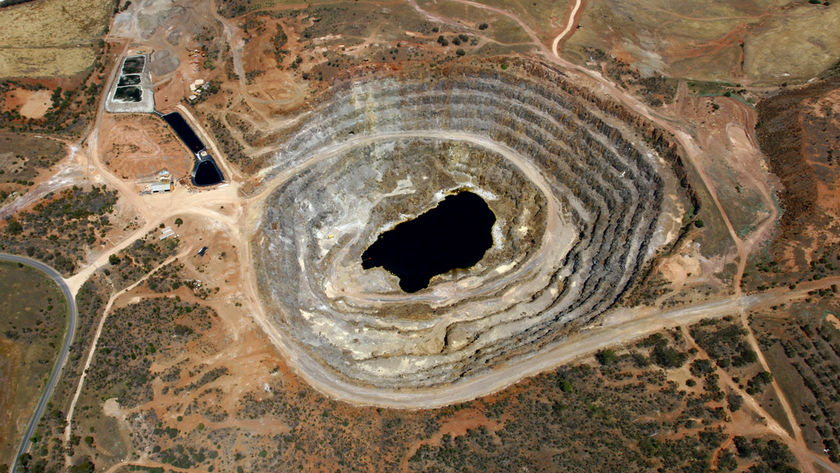
When I was a kid, I lived in Kanmantoo, a copper mining town on the east side of the South Mount Lofty Ranges in South Australia. I earned my pocket money working as a field assistant to various geologists and surveyors as they explored, drilled and mapped our region, searching for an el dorado.

After years of handling, cataloguing, archiving and assaying hard rock surface samples and drill cores, at a very young age I had developed a deep respect and basic understanding of the ancient tortured geology of my region.

I also developed a profound reverence for the science and practitioners of geology, quickly appreciating two of their quirks. The first was that geologists commonly taste rocks to help identify their nature. Depending on their composition, rocks have different flavours. Geologists lick rocks.

The second was that these remarkable people think in three dimensions. They learn to read the rock, and understand its intricate folds, rolls and layers deep beneath the Earth’s surface.


Once the great conical pit was dug at Kanmantoo (above), and one could stand in its depths, gazing over the mess of metamorphised hard rock in the faces reaching up for over two hundred metres to the surface, it was immediately obvious how thin and fickle the soil was.

Over all those three dimensional folds and curls of mighty rock, that epidermis of soil way above looked so frail, and inconsequential, and two-dimensional. Relatively, it had no depth.

MY BROTHER STEPHEN, ONE OF THE MINERS WHO DUG THE KANMANTOO PIT, IS STILL A HARDROCK UNDERGROUND MINER IN WESTERN AUSTRALIA

It made me shiver to wonder what sustenance had fed the world famous Kanmantoo St George's Vineyard during its blaze of fame from the beginning of the colony to the Depression. Like what on Earth - or in Earth - had lent this Adelaide Hills wine such flavour that it won the gold medal for best red wine in the world at the Paris Exposition Universelle of 1889, celebrating the centenary of the French Revolution and the opening of the Eiffel Tower?

The secret is unfolding still. Many years later, whilst working on the McLaren Vale map, the formidable geologist, Wolfgang Priess, reinforced my suspicion about the thin frailty of soil when he murmured “Some geologists think soil is the dandruff of the Earth.”

We had been discussing my frustration with viticulturers and winemakers, and their obsession with dirt, rather than geology. Soil, I was joking, was only two-dimensional compared to geology, which had depth, and flavour.

DIAMOND DRILL BITS FOR DRILLING CORE SAMPLES FROM DEEP IN THE EARTH - SEE BELOW

I had worked on the same office floor as Wolf, back in the ’seventies, when I was lucky to be part of the Geological Survey Division of the South Australian Department of Mines and Energy. This was a time when this new thing called “the environment” was only just being discovered. South Australia had a visionary Premier, Don Dunstan, whose regime oversaw the beginnings of progressive environment management and a slow-down in actual mining, but an incredible acceleration and intensification of exploration and mapping. That Department had a great fleet of drilling rigs, probably the biggest assembled in Australia 'til then, and it had a higher percentage of scientists with doctorates and significant academic qualifications than any other.

The frisson of creativity and discovery there was exciting, addictive and hugely rewarding: nearly four decades later, ore bodies discovered during that intensive exploratory surge are still being exposed and mined. The Olympic Dam deposit on Roxby Downs is a good example.

They certainly fed me and my crew with plenty of drill cores and rock samples for cataloguing, sampling, boxing and storage in the new Core Library at Glenside. We had thousands of kilometres of drill core samples there for immediate retrieval, examination and further analysis. This was the best facility of its type on Earth, where we built one of South Australia's first computer databases, using COBOL and a skrillion punch cards. Maire Mannik (below) was the brilliant pioneering programmer.

Elsewhere on that busy head office floor worked Jeff Olliver, who was head of the non-metallic minerals section. And twenty feet from me was W. A. “Bill” Fairburn, the fastidious boffin who edited the constant flow of academic papers the Survey produced. I learned an astonishing amount, listening to years of Bill’s tenacious questioning of the authors of those papers. Those bright discussions covered every strange backwater of the vast realm of geological science.

Geologists are thirsty folk. Interminable swathes of time spent nose down in the desert builds up significant reserves of thirst, which take mighty city lunches to assuage, nose to the winestone. Supervisor of many of these was my boss, the legendary Bob Wildy. Red wine, and much of it, was compulsory. The regular comparison and discussion of wines from the various South Australian viticulture regions led invariably to posturings on their relative geology. But not very deeply.

Eventually, after a study tour of the geologies of the wine regions of France, Bill Fairburn came back and addressed the Geological Survey, suggesting that a formal attempt be made to properly map the wine regions.

Bill’s address was rather humourously regarded: when there was gold and uranium to be found, his suggestion seemed frivolous. No funding was provided. But last month, thirty two years after that meeting, the first map was published.

Soon after Bill’s speech, I had largely abandoned rocks and went off to pursue my freelance writing career in television, film and papers. But those epochs of geological thirst led quickly to the world of wine writing, which increasingly became the focus of my hopeless attempts at earning a living.

A Michael Dransfield poem from 1972 had first led to me consider the relationship between wine and country, and the writing it could unleash. “Taste it. Not bitter,” Michael wrote of an old Hunter Shiraz in Wine Tasting, “but with the dust of the outback prominent.” A decade later, I was in the Hunter Valley being lectured by that almighty rogue, Murray Tyrrell.

“Our reds start out like young Bordeaux,” he boasted to a group of tourists, “and they end up like beyoootiful Burgundies.” And then, staring at me, “and you can smell the brown coal coming up through them from the ground beneath.”

I had already formed a strong belief that any coal/bitumen/peat/lignite characters possessed by the wines of the Hunter reflected the hydrogen sulphide in the air above, an exudate of the filthy local coal mining industry, rather than a product of the deep alluvial geology covering its coal strata. Any other H2S I suspected came from McLaren Vale, which shipped enormous volumes of its bulk wine into the Hunter for consequent blending, disguising and packaging as Hunter wine. Vales wines were stacked with sulphide from bad winemaking in those days. The Hunter vignerons had rather politely changed its common name from “rotten egg gas” to “sweaty saddle”, giving rise to evocative images of bushrangers, horse rustlers, and cattle thieves, all stereotypes fully understood by the Tyrrells.

Peaty Vales aromas, however, were another puzzle; one which took me a further 28 years to solve.

Pardon this meandering.

THE FREAKY TERAZZO-LIKE GEOLOGY OF THE TALUS SLOPE AT MARIUS WINES ON THE WILLUNGA FAULTLINE, McLAREN VALE. THIS ROCK, FROM VARIOUS 600 MILLION YEAR PLUS SOURCES IN AN ANCIENT MOUNTAIN RANGE, HAS BEEN BROKEN AND MIXED AND WORKED AND REWORKED BY GLACIAL ACTIONS AND EXTREME RIVERINE ENERGY AND THEN KER-SPLOSHED INTO ITS CURRENT LOCATION IN THE KURRAJONG FORMATION.

Very early in my winewriting career, I began to taste the rocks and dirt of the many vineyards I visited. The viticulturer’s reaction was always disbelief and horror. To me, the disbelieving reaction was preferred. Horror usually indicated a farmer who’d sprayed so much poison on his ground that he thought I must surely die from ingesting his poisons. There are plenty of those extant, unfortunately. Monstano's Roundup comes to mind. And I still encounter winemakers and grapegrowers who surprise me by doubting that the water-soluble mineral flavourants in their soil could possibly influence the flavour of the water that their vine roots drink, and squeeze up and out into their berries.

Bill Fairburn corresponded with me irregularly during my twenty years writing wine on The Advertiser, the local metropolitan and state daily. He would enjoy setting me right when my geological posturing went awry, was always helpful when I encountered strange geologies on my endless vineyard treks, and often vented his frustration that he couldn’t get support from any winemakers for his map-making efforts. He would spend weekends and holidays in the field with his geological pick and notepad, mapping geology. McLaren Vale, and then the Barossa.

Botched, hurried versions of his work made it onto two government pamphlets in 2000. The lack of interest from the winemakers of both regions was deplorable. The owner of one trendy Barossa old-vine boutique whose vines Bill recognized to be dying of salinity from stupid irrigation regimes hissed “who gives a fuck about geology”, and sent him packing.

So Bill did pack. Packed right up and went back to Yorkshire to retire.

In 2008 I moved from Kanmantoo to McLaren Vale, where I discovered Jeff Olliver was living, growing grapes, and working as a consulting geologist. We immediately decided to pursue Bill’s work, and renew contact with him. This coincided with Dudley Brown, new chairman of the McLaren Vale Grape Wine And Tourism Association, visiting me to discuss the need for a map of the McLaren Vale Wine Region.

JEFF OLLIVER CUDDLES A PIECE OF FOSSILISED TREE TRUNK FROM BAKER GULLY, IN THE NORTH-EAST CORNER OF McLAREN VALE photo KATE ELMES

"Map?”, I said. “I can get you a map!” And I proceeded to tell him the long tale. Dudley's Association quickly set up a committee, chaired by Jock Harvey, his predecessor at the Association, and on we went. Bill paid his own fare back from York, where his retirement involved him rewriting the geology of a significant slice of north east England, and off we went.

Fortunately, Wolfgang Preiss was still working in the Geological Survey, where he is the senior geologist. So with his estimable assistance and peer approval, the four of us set about finalizing Bill’s work and getting the map published.

This involved some big help from the local member of parliament, Leon Bignell, and assistance from wine-loving cabinet minister, Patrick Conlon. Andrew Rowett of the Geological Survey was also an enormous help and facilitator.

Back-up work came from Bill’s friend Jo Thyer and Jeff’s wife Susan, whom he met away back in our Department days, and who was employed by the same geologist who gave me my job, the late Peter Dunlop.

The Geology Of The McLaren Vale Wine Region is now available from the McLaren Vale Visitor’s Centre, various Vales wineries, and the current version of the old Department of Mines, which is now part of Primary Industries And Resources, South Australia. Whose acronym, PIRSA, is a vast improvement on that of the department I quit all those years years ago, the South Australian Department of Mines and Energy.

THE AUTHOR ADDRESSING THE WINEMAKERS AND VITICULTURERS AT THE LAUNCH OF THE GEOLOGY OF THE McLAREN VALE WINE REGION MAP IN THE BOCCE CLUB, McLAREN VALE photo LEO DAVIS

09 June 2010

LEONARDO'S LITTLE FLAME STILL BURNING


-->WHY ARE THERE NO SHEILAHS AT THIS LUNCH? THERE WERE ABOUT FIFTEEN THERE ACTUALLY, BUT LEONARDO MADE 'EM GET OUT OF THE WAY FOR THE CAMERA!
Virgo Nut Admits Hun Pen Fetish
Bic Owes Da
Vincis Whole Motza
Something A Little Lighter From The Archive

by PHILIP WHITE

Being just about the most virgoan of virgoans, I’m a fanatic about the way I hang my washing on the line: all the tea-towels there with red pegs; the tee shirts there with blue pegs; the bedsheets there with yellow; socks in pairs with green.

It’s an exercise that also challenges my chronic colour-blindness. I can sort them darn pegs into colours! No flies on Whitey!

Any neighbouring lass who sees my clothesline just has to mutter “Wow!” Then it’s out with the john and tinic and into the violin playing.

Which leads me to the matter of the quality of clothes pegs. I’d been really shitty about the Chinese ones I’d persevered with for months: damn things kept popping open and springing to useless bits, leaving the jeans in the dirt and my sheets halfway across the vineyard.

So I broke open the vaults and bought some nice new French ones. Red, white and blue. Bic.

I often wonder how much money the Bics owe the estate of Leonardo da Vinci. The two gadgets they’ve made their scrillions from were both invented by him.

The first is the ball-point pen, which uses a ball-bearing.

Leonardo (below) invented the ball-bearing, and the ball race. M. Bic merely put the ball in a writing stick, filled it with sorbitol-moistened ink instead of oil or grease, and soon bought a yacht that takes about half an hour to walk past.

But only one of Leo’s inventions went into production before his death: the wheel-lock.

And that's not something sticker-lickers use to bolt your car down.

In his day, countless thousands of musketeers ended up impaled on enemy pikes because their damned muskets misfired, or never fired at all. There was only one spark from the flintlock, and if the charge didn’t ignite and send the ball flying off into the enemy on the first pop, the poor buggers would have to empty the barrel of gunpowder without blowing themselves up, recharge it, pack it all back with the ramrod, put new powder on the flash pan, cock the hammer, aim, and have another go, by which time the pike had got well and truly into their gizzards.

Leo thought awhile and reckoned he should devise a method of extending the duration of the spark. So, using the mechanism of a spiral door spring, and a dismountable crank handle, he built a musket that wound a serrated wheel over the flint, giving a good few seconds of constant spark. Fizzzz ... BANG! The wheel-lock musket. Suddenly it was the pikemen getting their gizzards spread, and Leo rose to favour in the eyes of the King.

Who was probably Piero Antinori’s great grandfather.

Anyway, the Bic family cunningly turned this, the wheel lock, into the Bic Flick cigarette lighter, and whole generations of us are dying of lung cancer without ever having to strike a match.

So, apart from the fact that this writer once sprang Murray Tyrrell for adding sorbitol to his wines, which is highly illegal, what’s this got to do with the Devil’s Brew? Well, obviously, a wine writer needs a pen, although I can’t abide a ball point. You can’t write cursive copperplate with a friggin Biro – it’s the Deux Chevaux of writing sticks.

It works, but won’t get you picking up Lucinda Williams at the Strath dances.

Nossir Ma’am, since high school I’ve been addicted to the Germans for scribe’s tools: you can’t beat the old Hun Rotring Rapidograph technical drawing pen. You can’t write copperplate cursive with one of them, either, mind you, but if you affect eccentric spidery microscopic writing like mine -- you need fewer notepads – the old needlepoint is impossible to beat.

DIARY FROM MY SCHOOLDAYS ... THE SCRIPT IS NEVER TALLER THAN 1.5 MILLIMETRES, BUT IT'S STILL QUITE READABLE

Besides, the Rapidograph uses indian ink, so you can spill a whole magnum of Margaux on your notes and they’ll never smudge or fade away.

Rotring ventured into the conventional fountain pen business for a few years, and couldn’t get it right. I loved my matte gunmetal black hexagonal-barreled brass-bodied model, which reminded me of an old Winchester carbine, but the Huns somehow got the cap catch all wonky, and when you wore the pen on its clip in your chest pocket, the pen would fall out of the cap and spread Quink Royal Blue (same colour the Duke of Edinburgh uses) all over your Savile Row suit and Richard Anderson shirt.

Not to mention the Krug tie, if you happened to have been listing to port.

A man could wake up with an enemy pike through him

On about the tenth time I returned that beloved Rotring fountain to the vendor to have the problem fixed, the sanctimonious bitch behind the counter advised primly that Rotring had sold out to Parker who’d immediately ceased production of said macho chickmagnet and accepted no responsibility for inadequacies of their production.

For a moment I thought she meant Robert Parker Jr., who would go and do something like that, then increase the width of the nibs to about seven inches.

“Just because you’re paranoid doesn’t mean he’s not getting you Whitey”, I told myself sagely, before remembering that Phil the Duc uses a Parker, which is a pen and doesn’t come from a house with a glass-topped table in Maryland, which is what them Parkers have on their fluffy carpet.

Glass-topped table, glass-bottomed bed I always say.

Something the farting bulldog can watch through.

Anyway she hated me for regularly bringing that pen back for repairs under warranty, especially when I reminded her that for eighty-four-point-seven-five per centum of the duration of my ownership of it, the lovely black brute was off in Sydney or Hamburg or someplace getting its lid fixed.

I bust into a cold sweat, imagining the Rapidograph, too, had gone.

A few panicky phone calls got me through to somebody in Sydney who promised Rotring was in the technical pen stakes for ever, at which point the pike came back outa my chest and I muttered something about Rotring needing Leonardo and never saw that woman again.

She sold the shop, actually, before she drove all her customers away. The new people are utterly polite and charming, but those beautiful Rotring fountains have never been seen since, which is a horrible shame. I reckon a touch of Bismarkian perseverance would have sorted it eventually. Damn!

Anyway the Rapidograph needlepoint technical is my main side arm still.

And short of Rotring making clothespegs, I’ll stick with Bic for the clothesline art.

I wonder if Leonardo invented the clothespeg?

31 August 2009

BASS PHILLIP DANCES TANGO IN EXETER

THE TWO PHILS GETTING FULL OF BASS PHILLIP DURING JONESEY'S PHILIPPIC IN THE EX ... all photography MILTON WORDLEY

Phillip (sic) Jones Brings Bass Phillip (sic) To Fill Up Philip The Pinot Sicko ... One L Of A Night In The X
by PHILIP WHITE

Phillip Jones came to The Exeter for a few slow quiet ones last week. An engineer who fell in love with pinot noir is a scarce beast. An engineer who so frequently masters the mystical and confounding nature of such an ethereal drinking genie is an absolute rarity. For Jones is a passionate and erudite man, and makes his wines with the flesh of his hands and feet rather than employing anything as harsh and brash as a pump.

I first suspected this man had studied and practised engineering purely to eventually focus all his engineering skills upon one critical job: the disconnection of his brains from his heart, as he seems to run most of his life with the latter organ. Which is, as any cardio surgeon will tell you, a lot more visceral and gentle on the life-juice than your average open-throat mono pump made of steel. And which is never to say Jones is not an highly captivating and rewarding conversationalist. After an evening wallowing in his estimable company, one could only wonder what in the hell his engineering was like. You don’t get sensual engineers.

Away back in the ’seventies, when Jones began his errant vineyard dreaming, there was bugger all of this weird Burgundian variety about. Murray Tyrrell had a patch in the Hunter; having tired of the frustrating monoculture and frosts of Coonawarra, David Wynn was planting it at Mountadam on the High Eden Ridge. The most common one was the Hardy’s Keppoch, a vast-volume cheapy made from a huge monoclonal vineyard near Padthaway. And that clone was in fact a sparkling wine model, so the chances of it being a great red pinot were remote. That wasn’t what Jones had in mind.

Although he started out growing Bordeaux varieties, he sought somewhere as cold and damp and humid as Burgundy, south-east of Melbourne. He passed the outbreak of Jaguar XJ12s of the Yarra Valley, and even the Ferrari and Porsche appellation of Mornington Peninsula. This obsession was no hobby. He went to Leongatha, away down near Victoria’s southernmost point, Wilson’s Promontory, at the bottom corner of wet old Gippsland.


Leongatha’s wetter than Burgundy. Mainly dairy and onion country, it gets over 1000 millimetres a year. It rains roughly every second day from April through October. The average daily maximum temperature peaks at 26 in January and February, but through June and August it’s all twelves and thirteens. The critical mean’s 18.2.

So much water is not much of a problem: the extremely deep loose soils south of the mountain ash country of the Strzelecki Ranges just soaks it up. “It’s so absorbent there are hardly any rivers”, Jones tells his glass disbelievingly. “But jeez the rain brings the moulds. I can’t spray 500 in the ripening season.” He refers here to the biodynamic preparation which encourages white fungal tendrils to sprout in the soil, where they perform a healthy enlivening function, and somehow assist the vine roots to better extract every hint of mineral. “Unfortunately, 500 also encourages moulds in the foliage when it’s so wet,” he said. “There’s so much cloud that light management is more critical: I fine tune it with 501. It’s all about canopy and light management.” 501 is the silica-based biodynamic preparation which works as a light diffuser.

Jones now takes his fruit from four sites spread over 24 kilometres of country. “Every site is different,” he said. “Like the ferric soils require a different approach and give different flavours to the ferrous.”

Because he wanted low yields – hard to get in such prosperous country – he planted his vines very, very close: 9000 vines per hectare. Most of Australia’s vineyards sit on about 2000. He thins everything: leaves, tendrils and bunches, to limit his yields to 250-350 grams of grapes per vine. Then his winemaking is more like a lyrical slither than anything industrial. And his wines? Sloppy, stupefying, seductive dances all. Make that dancers.

Constant high humidity, as in Burgundy at vintage, does something to the tannins of grapes, which are highly concentrated around the skin’s pores, which constantly transpire water. A single variety grown to a certain ripeness in a dry place will generally be harder of tannin than the humid model, perhaps due to the background humidity limiting the amount of transpiration. Jones’s Bass Phillip pinots show this to the extreme. “In older vineyards, the humidity really brings out the provocative aromatics,” he said. They also seem softer, plumper, and wetter. Freakishly Burgundian. Yet below each peculiar beauty, there is the tickling piquancy of the soil and the rock from whence it came.

Away down at the bottom of Australia, Bacchus and Pan do the tango, held up by the Norman Lindsay lasses, the Rubens mob having occupied every couch. Soused in Guerlain’s Jicky, of course.

Bass Phillip Estate 21 Gippsland Pinot Noir 2006
$53.75; 12.8% alcohol; cork; 93+++ points
This, the twenty-first vintage, came from a difficult year, in which Phillip Jones says he “blended everything” to make this wondrous confrontation. It smells like maraschino cherries soused in lemon juice, with a whole barrage of other stuff coming in soon after: the potato sack earth, the gingery oak, the plump dancing girls. In fact, my notes are specific about the lass here in question: it’s Vanessa Redgrave’s Isadora: dancing like a giraffe, then too keen to leap into the deadly Bugatti, the silk scarf immediately dragging the neck t’wards the beautifully spoked wheel. Give it six years, breath in, accelerate. (All my other Bass Phillip notes were stolen in the Great Bag Heist of 09)

PHILLIP JONES CLINKS PINOTS WITH EXETER PUBLICAN KEVIN GREG ... IN BACKGROUND, WRITER LANCE CAMPBELL (LEFT), WITH WINE MERCHANT PAUL JAMES. all photography: MILTON WORDLEY

09 February 2009

WHITEY’S LIFE WITH LEONARDO DA VINCI

WHY ARE THERE NO SHEILAHS AT THIS LUNCH? THERE WERE ABOUT FIFTEEN THERE ACTUALLY, BUT LEONARDO MADE 'EM GET OUT OF THE WAY FOR THE CAMERA!


Virgo Nut Admits Hun Pen Fetish

Frogs Owe da Vincis The Earth

by PHILIP WHITE


Being just about the most virgoan of virgoans, I’m a fanatic about the way I hang my washing on the line: all the tea-towels there with red pegs; the tee shirts there with blue pegs; the bedsheets there with yellow; socks in pairs with green.


It’s an exercise that also challenges my chronic colour-blindness. I can sort them darn pegs into colours! No flies on Whitey!


Any neighbouring lass who sees my clothesline just has to mutter “Wow!” Then it’s out with the john and tinic and into the violin playing.


Which leads me to the matter of the quality of clothes pegs. I’d been really shitty about the Chinese ones I’d persevered with for months: damn things kept popping open and springing to useless bits, leaving the jeans in the dirt and my sheets halfway across the vineyard.


So I broke open the vaults and bought some nice new French ones. Red, white and blue. Bic.


I often wonder how much money the Bics owe the estate of Leonardo da Vinci. The two gadgets they’ve made their scrillions from were both invented by him.


The first is the ball-point pen, which uses a ball-bearing.


Leonardo (below) invented the ball-bearing, and the ball race. M. Bic merely put the ball in a writing stick, filled it with sorbitol-moistened ink instead of oil or grease, and soon bought a yacht that takes about half an hour to walk past.


But only one of Leo’s inventions went into production before his death: the wheel-lock.


And that's not something sticker-lickers use to bolt your car down.


In his day, countless thousands of musketeers ended up impaled on enemy pikes because their damned muskets misfired, or never fired at all. There was only one spark from the flintlock, and if the charge didn’t ignite and send the ball flying off into the enemy on the first pop, the poor buggers would have to empty the barrel of gunpowder without blowing themselves up, recharge it, pack it all back with the ramrod, put new powder on the flash pan, cock the hammer, aim, and have another go, by which time the pike had got well and truly into their gizzards.


Leo thought awhile and reckoned he should devise a method of extending the duration of the spark. So, using the mechanism of a spiral door spring, and a dismountable crank handle, he built a musket that wound a serrated wheel over the flint, giving a good few seconds of constant spark. Fizzzz ... BANG! The wheel-lock musket. Suddenly it was the pikemen getting their gizzards spread, and Leo rose to favour in the eyes of the King.


Who was probably Piero Antinori’s great grandfather.


Anyway, the Bic family cunningly turned this, the wheel lock, into the Bic Flick cigarette lighter, and whole generations of us are dying of lung cancer without ever having to strike a match.


So, apart from the fact that this writer once sprang Murray Tyrrell for adding sorbitol to his wines, which is highly illegal, what’s this got to do with the Devil’s Brew? Well, obviously, a wine writer needs a pen, although I can’t abide a ball point. You can’t write cursive copperplate with a friggin Biro – it’s the Deux Chevaux of writing sticks.


It works, but won’t get you picking up Lucinda Williams at the Strath dances.


Nossir Ma’am, since high school I’ve been addicted to the Germans for scribe’s tools: you can’t beat the old Hun Rotring Rapidograph technical drawing pen. You can’t write copperplate cursive with one of them, either, mind you, but if you affect eccentric spidery microscopic writing like mine -- you need fewer notepads – the old needlepoint is impossible to beat.


(Click on schooldays pocket diary below. Note the size of the script: never much over 1.5ml., but perfectly legible. Please don't read it - it's private!)


Besides, the Rapidograph uses indian ink, so you can spill a whole magnum of Margaux on your notes and they’ll never smudge or fade away.


Rotring ventured into the conventional fountain pen business for a few years, and couldn’t get it right. I loved my matte gunmetal black hexagonal-barreled brass-bodied model, which reminded me of an old Winchester carbine, but the Huns somehow got the cap catch all wonky, and when you wore the pen on its clip in your chest pocket, the pen would fall out of the cap and spread Quink Royal Blue (same colour the Duke of Edinburgh uses) all over your Savile Row suit and Richard Anderson shirt.


Not to mention the Krug tie, if you happened to have been listing to port.


A man could wake up with an enemy pike through him


On about the tenth time I returned that beloved Rotring fountain to the vendor to have the problem fixed, the sanctimonious pseudo-Christian bitch behind the counter advised primly that Rotring had sold out to Parker who’d immediately ceased production of said macho chickmagnet and accepted no responsibility for inadequacies of their production.


For a moment I thought she meant Robert Parker Jr., who would go and do something like that, then increase the width of the nibs to about seven inches.


“Just because you’re paranoid doesn’t mean he’s not getting you Whitey”, I told myself sagely, before remembering that Phil the Duc uses a Parker, which is a pen and doesn’t come from a house with a glass-topped table in Maryland, which is what them Parkers have on their fluffy carpet.


Glass-topped table, glass-bottomed bed I always say. Something the farting bulldog can watch through.


Anyway she hated me for regularly bringing that pen back for repairs under warranty, especially when I reminded her that for eighty-four-point-seven-five per centum of the duration of my ownership of it, the lovely black brute was off in Sydney or Hamburg or someplace getting its lid fixed.


I bust into a cold sweat, imagining the Rapidograph, too, had gone.


A few panicky phone calls got me through to somebody in Sydney who promised Rotring was in the technical pen stakes for ever, at which point the pike came back outa my chest and I muttered something about Rotring needing Leonardo and never saw that woman again.


She sold the shop, actually, before she drove all her customers away. The new people are utterly polite and charming, but those beautiful Rotring fountains have never been seen since, which is a horrible shame. I reckon a touch of Bismarkian perseverance would have sorted it eventually. Damn!


Anyway the Rapidograph needlepoint technical is my main side arm still.


And short of Rotring making clothespegs, I’ll stick with Bic for the clothesline art.


I wonder if Leonardo invented the clothespeg?

.