


COONAWARRA HAS NO COPYRIGHT ON LIMESTONE: EOCENE BLANCHE POINT AND TORTACHILLA LIMESTONE IN THE TUNNEL BELOW MAXWELL WINES
Leon Bignell's Speech
The House Of Assembly
South Australian Parliament
by LEON BIGNELL, MEMBER FOR MAWSON, 21 July 2010
Mr BIGNELL (Mawson) (15:30): I rise today to inform the house of a new map that was released last week. It is a geological map that shows the different rock formations in the McLaren Vale region. Some of those rocks date back 1.6 billion years. It is very important for a winegrowing region to understand what is below the soil. In fact, there is a huge impact on wine, depending on what sort of rocks it is grown upon.
I would really like to congratulate Philip White, the wine critic, Jeffrey Olliver, PIRSA's geologist Wolfgang Priess and William Fairburn who, 35 years ago, when they were working together here in Adelaide and all very much interested in geology, came up with the idea of mapping South Australia's wine regions, their geological formations and their importance. It took a while and there were several years of no activity at all but, for these four guys, their dream became a reality last week. I would also like to thank PIRSA for its contribution in helping make this map a possibility.
There were more than 140 people at the Bocce Club at McLaren Vale for the launch of the map last week, showing just how important it is to the region. There are seven distinct terrains in the McLaren Vale wine region and, as I said, each of those has a very important impact on the taste of the wine, which is why people may have seen Philip White getting around in vineyards over recent years, licking rocks. It always looks a little strange, but he says that what you taste in the wine is what you taste in the rocks, and I will take Whitey's word for that.

REFLECTED IN WHITEY'S SHADES IS THE INTERFACE WHERE THE NEOPROTEROZOIC BEDROCK UNDELIES THE NORTH MASLIN SANDS AT THE CUTTING NEAR CHAPEL HILL: 700 MILLION YEARS OF GEOLOGY MISSING! photo KATE ELMES
Ms Bedford interjecting:
Mr BIGNELL: He is very dedicated, and he is also a very avid reader of Hansard, and I am sure that he will be reading this note of congratulation. We have also had another big week. I have come in here many times to talk about what a wonderful region McLaren Vale is. Two nights ago in Melbourne at the National Produce Awards, McLaren Vale was named by Delicious magazine the best region in Australia. This is what the judges had to say:
"With its mix of outstanding wineries and restaurants, great produce and a stunning coastline, South Australia's McLaren Vale was the natural choice as this year's winner. Being a wine region by the sea is definitely an advantage. The chefs here at places like Fino, Salopian Inn and Russell's really know how to make the most of the produce and seafood, and the Willunga Farmers Market is a highlight. There's a great synergy. It's one of the most active regions in the country for permaculture, and you see it at the market."
 PARLIAMENTARY MEMBER FOR THE SEAT OF MAWSON, LEON BIGNELL, HELPING OUT IN DUDLEY BROWN'S INKWELL VINEYARD
Coming to the world of wine from deep beneath the flavoured ground
by PHILIP WHITE
When I was a kid, I lived in Kanmantoo, a copper mining town on the east side of the South Mount Lofty Ranges in South Australia. I earned my pocket money working as a field assistant to various geologists and surveyors as they explored, drilled and mapped our region, searching for an el dorado.
After years of handling, cataloguing, archiving and assaying hard rock surface samples and drill cores, at a very young age I had developed a deep respect and basic understanding of the ancient tortured geology of my region.
I also developed a profound reverence for the science and practitioners of geology, quickly appreciating two of their quirks. The first was that geologists commonly taste rocks to help identify their nature. Depending on their composition, rocks have different flavours. Geologists lick rocks.
The second was that these remarkable people think in three dimensions. They learn to read the rock, and understand its intricate folds, rolls and layers deep beneath the Earth’s surface.
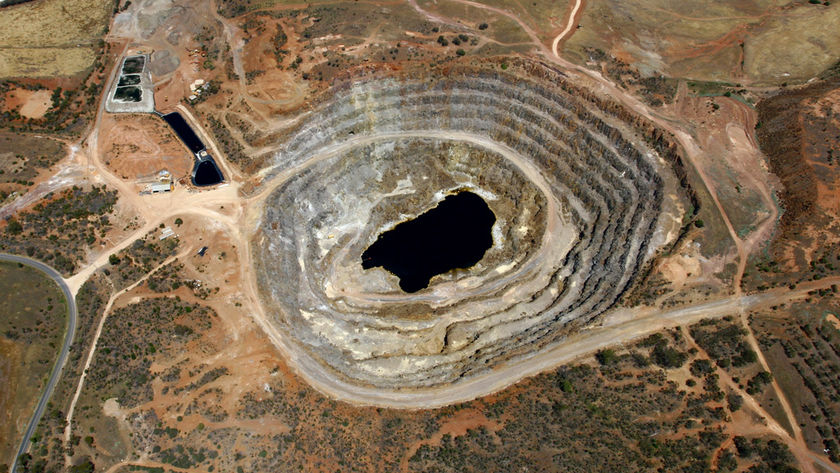
Once the great conical pit was dug at Kanmantoo (above), and one could stand in its depths, gazing over the mess of metamorphised hard rock in the faces reaching up for over two hundred metres to the surface, it was immediately obvious how thin and fickle the soil was.
Over all those three dimensional folds and curls of mighty rock, that epidermis of soil way above looked so frail, and inconsequential, and two-dimensional. Relatively, it had no depth.
 MY BROTHER STEPHEN, ONE OF THE MINERS WHO DUG THE KANMANTOO PIT, IS STILL A HARDROCK UNDERGROUND MINER IN WESTERN AUSTRALIA
It made me shiver to wonder what sustenance had fed the world famous Kanmantoo St George's Vineyard during its blaze of fame from the beginning of the colony to the Depression. Like what on Earth - or in Earth - had lent this Adelaide Hills wine such flavour that it won the gold medal for best red wine in the world at the Paris Exposition Universelle of 1889, celebrating the centenary of the French Revolution and the opening of the Eiffel Tower?
The secret is unfolding still. Many years later, whilst working on the McLaren Vale map, the formidable geologist, Wolfgang Priess, reinforced my suspicion about the thin frailty of soil when he murmured “Some geologists think soil is the dandruff of the Earth.”
We had been discussing my frustration with viticulturers and winemakers, and their obsession with dirt, rather than geology. Soil, I was joking, was only two-dimensional compared to geology, which had depth, and flavour.
 DIAMOND DRILL BITS FOR DRILLING CORE SAMPLES FROM DEEP IN THE EARTH - SEE BELOW
I had worked on the same office floor as Wolf, back in the ’seventies, when I was lucky to be part of the Geological Survey Division of the South Australian Department of Mines and Energy. This was a time when this new thing called “the environment” was only just being discovered. South Australia had a visionary Premier, Don Dunstan, whose regime oversaw the beginnings of progressive environment management and a slow-down in actual mining, but an incredible acceleration and intensification of exploration and mapping. That Department had a great fleet of drilling rigs, probably the biggest assembled in Australia 'til then, and it had a higher percentage of scientists with doctorates and significant academic qualifications than any other.
The frisson of creativity and discovery there was exciting, addictive and hugely rewarding: nearly four decades later, ore bodies discovered during that intensive exploratory surge are still being exposed and mined. The Olympic Dam deposit on Roxby Downs is a good example.
They certainly fed me and my crew with plenty of drill cores and rock samples for cataloguing, sampling, boxing and storage in the new Core Library at Glenside. We had thousands of kilometres of drill core samples there for immediate retrieval, examination and further analysis. This was the best facility of its type on Earth, where we built one of South Australia's first computer databases, using COBOL and a skrillion punch cards. Maire Mannik (below) was the brilliant pioneering programmer.
 Elsewhere on that busy head office floor worked Jeff Olliver, who was head of the non-metallic minerals section. And twenty feet from me was W. A. “Bill” Fairburn, the fastidious boffin who edited the constant flow of academic papers the Survey produced. I learned an astonishing amount, listening to years of Bill’s tenacious questioning of the authors of those papers. Those bright discussions covered every strange backwater of the vast realm of geological science.
Geologists are thirsty folk. Interminable swathes of time spent nose down in the desert builds up significant reserves of thirst, which take mighty city lunches to assuage, nose to the winestone. Supervisor of many of these was my boss, the legendary Bob Wildy. Red wine, and much of it, was compulsory. The regular comparison and discussion of wines from the various South Australian viticulture regions led invariably to posturings on their relative geology. But not very deeply.
Eventually, after a study tour of the geologies of the wine regions of France, Bill Fairburn came back and addressed the Geological Survey, suggesting that a formal attempt be made to properly map the wine regions.
 Bill’s address was rather humourously regarded: when there was gold and uranium to be found, his suggestion seemed frivolous. No funding was provided. But last month, thirty two years after that meeting, the first map was published.
Soon after Bill’s speech, I had largely abandoned rocks and went off to pursue my freelance writing career in television, film and papers. But those epochs of geological thirst led quickly to the world of wine writing, which increasingly became the focus of my hopeless attempts at earning a living.
A Michael Dransfield poem from 1972 had first led to me consider the relationship between wine and country, and the writing it could unleash. “Taste it. Not bitter,” Michael wrote of an old Hunter Shiraz in Wine Tasting, “but with the dust of the outback prominent.” A decade later, I was in the Hunter Valley being lectured by that almighty rogue, Murray Tyrrell.
“Our reds start out like young Bordeaux,” he boasted to a group of tourists, “and they end up like beyoootiful Burgundies.” And then, staring at me, “and you can smell the brown coal coming up through them from the ground beneath.”
I had already formed a strong belief that any coal/bitumen/peat/lignite characters possessed by the wines of the Hunter reflected the hydrogen sulphide in the air above, an exudate of the filthy local coal mining industry, rather than a product of the deep alluvial geology covering its coal strata. Any other H2S I suspected came from McLaren Vale, which shipped enormous volumes of its bulk wine into the Hunter for consequent blending, disguising and packaging as Hunter wine. Vales wines were stacked with sulphide from bad winemaking in those days. The Hunter vignerons had rather politely changed its common name from “rotten egg gas” to “sweaty saddle”, giving rise to evocative images of bushrangers, horse rustlers, and cattle thieves, all stereotypes fully understood by the Tyrrells.
Peaty Vales aromas, however, were another puzzle; one which took me a further 28 years to solve.
Pardon this meandering.
 THE FREAKY TERAZZO-LIKE GEOLOGY OF THE TALUS SLOPE AT MARIUS WINES ON THE WILLUNGA FAULTLINE, McLAREN VALE. THIS ROCK, FROM VARIOUS 600 MILLION YEAR PLUS SOURCES IN AN ANCIENT MOUNTAIN RANGE, HAS BEEN BROKEN AND MIXED AND WORKED AND REWORKED BY GLACIAL ACTIONS AND EXTREME RIVERINE ENERGY AND THEN KER-SPLOSHED INTO ITS CURRENT LOCATION IN THE KURRAJONG FORMATION.
Very early in my winewriting career, I began to taste the rocks and dirt of the many vineyards I visited. The viticulturer’s reaction was always disbelief and horror. To me, the disbelieving reaction was preferred. Horror usually indicated a farmer who’d sprayed so much poison on his ground that he thought I must surely die from ingesting his poisons. There are plenty of those extant, unfortunately. Monstano's Roundup comes to mind. And I still encounter winemakers and grapegrowers who surprise me by doubting that the water-soluble mineral flavourants in their soil could possibly influence the flavour of the water that their vine roots drink, and squeeze up and out into their berries.
Bill Fairburn corresponded with me irregularly during my twenty years writing wine on The Advertiser, the local metropolitan and state daily. He would enjoy setting me right when my geological posturing went awry, was always helpful when I encountered strange geologies on my endless vineyard treks, and often vented his frustration that he couldn’t get support from any winemakers for his map-making efforts. He would spend weekends and holidays in the field with his geological pick and notepad, mapping geology. McLaren Vale, and then the Barossa.
Botched, hurried versions of his work made it onto two government pamphlets in 2000. The lack of interest from the winemakers of both regions was deplorable. The owner of one trendy Barossa old-vine boutique whose vines Bill recognized to be dying of salinity from stupid irrigation regimes hissed “who gives a fuck about geology”, and sent him packing.
So Bill did pack. Packed right up and went back to Yorkshire to retire.
In 2008 I moved from Kanmantoo to McLaren Vale, where I discovered Jeff Olliver was living, growing grapes, and working as a consulting geologist. We immediately decided to pursue Bill’s work, and renew contact with him. This coincided with Dudley Brown, new chairman of the McLaren Vale Grape Wine And Tourism Association, visiting me to discuss the need for a map of the McLaren Vale Wine Region.
 JEFF OLLIVER CUDDLES A PIECE OF FOSSILISED TREE TRUNK FROM BAKER GULLY, IN THE NORTH-EAST CORNER OF McLAREN VALE photo KATE ELMES
"Map?”, I said. “I can get you a map!” And I proceeded to tell him the long tale. Dudley's Association quickly set up a committee, chaired by Jock Harvey, his predecessor at the Association, and on we went. Bill paid his own fare back from York, where his retirement involved him rewriting the geology of a significant slice of north east England, and off we went.
Fortunately, Wolfgang Preiss was still working in the Geological Survey, where he is the senior geologist. So with his estimable assistance and peer approval, the four of us set about finalizing Bill’s work and getting the map published.
This involved some big help from the local member of parliament, Leon Bignell, and assistance from wine-loving cabinet minister, Patrick Conlon. Andrew Rowett of the Geological Survey was also an enormous help and facilitator.
Back-up work came from Bill’s friend Jo Thyer and Jeff’s wife Susan, whom he met away back in our Department days, and who was employed by the same geologist who gave me my job, the late Peter Dunlop.
The Geology Of The McLaren Vale Wine Region is now available from the McLaren Vale Visitor’s Centre, various Vales wineries, and the current version of the old Department of Mines, which is now part of Primary Industries And Resources, South Australia. Whose acronym, PIRSA, is a vast improvement on that of the department I quit all those years years ago, the South Australian Department of Mines and Energy.
 THE AUTHOR ADDRESSING THE WINEMAKERS AND VITICULTURERS AT THE LAUNCH OF THE GEOLOGY OF THE McLAREN VALE WINE REGION MAP IN THE BOCCE CLUB, McLAREN VALE photo LEO DAVIS


