photo Philip White
Amphora leaks getting sealed
Fermenting in the vineyard dirt
Science changing potter's role
by PHILIP WHITE
"Everyone seems to think the Greeks and Romans used
clay as a container to age wines," John Ullinger says, reflecting on the
current amphora fad amongst winemakers. "They can't have used clay to age
wine, or store it for any great time. It was just too porous. I'm informed by
the ancients, but if they were here today, and saw our technology, they'd fire
everything at a higher temperature. They couldn't get their kilns hot enough to
get clay to glaze properly and seal.
"They probably hated amphora!
"This current fascination in amphora intrigues me. If
you go and buy yourself a real one, after the style of the ancients, to prevent
it from leaking you'd have to seal it with resin or wax, which seems to defeat
the purpose of using natural clay. If the Romans or the Phoenecians had our kiln
technology, they'd be glazing those surfaces at higher temperatures and they'd discover
that everything would keep better."
John's a potter. We've been mates for decades. He did what he calls "a typical standard
arts/crafts/design degree" at the University South Australia, where he
says they taught some basic geology about clays and their sources, but says
"most people never use that stuff; that knowledge."
John's determined to use his. He went off and did his masters
at Stoke-on-Trent, which he says gave him "a full-on industrial ceramic
design qualification." He was clearly thinking industrially when he rang
me a year ago to ask whether there was any clay on the Yangarra vineyard (where
I rent a small flat). He said he was amused at the thought of the modern wine
business suddenly copying an ancient imperfect container, which he
knew he could easily improve.
John liked my suggestion that once the Romans invaded Gaul,
and discovered that the canny woodworking Celts had invented the oak barrel, it
didn't take long for the brittle, leaky clay to disappear. What wasn't on the
bottom of the Mediterranean soon became builders' landfill at the Coliseum or terra
cotta road metal.
"Like in the name of getting back to nature, what's
the point of going for something as natural and tricky as clay, and then having
to seal it with a contaminant like beeswax or pine resin so it doesn't leak,
which in turn means the wine has no contact with the clay? The industrial
scientist in me says this is the pursuit of nature for the sake of it, and then
not going the whole hog because it doesn't work very well ... marketing.
"Perhaps it's more the artist in me that started
this thinking, but really I'd like to see what happens if you ferment a wine
in an amphora made from the same ground the vines grew in," he said.
This was revolutionary thinking.
photo Philip White
When I told him that yes, Yangarra has plenty of clay, he
was down here in a flash, taking samples. Buckets of it, from different parts of
the big vineyard. Manager and chief winemaker Peter Fraser was right into the
idea, as he was already trialling modern commercial "egg" fermenters
in place of steel or oak, and spectacularly with Roussanne. The stoic and bemused
vineyard genius, Michael Lane, suddenly found himself making large mud pies
with the back hoe.
After many trials of breaking, soaking and settling the
clays to fine them, and lots of experimental kiln work and research of the
varying compositions of samples from the vineyard's different geologies, John
returned with a set of 30-50 litre clay pots. As not all the vineyard clays
were suitable for casting big pots, some were made from a blend of the vineyard
ground with a neutral industrial amalgam clay. What some would call a
"pure" clay.
Like blending wine, see?
Fascinated first with the notion of really testing the
relationship between the actual flavours of the clay and the wine fermented in
it, without leakage, John's making pots of varying compositions, with different
levels of organics, silica and iron, depending on the clay source. And he's
glazing them on the outside, not the other way around. As it ferments, the wine
soaks into the same ground it grew in.
"Only the Georgians of Caucasia mastered the leaky old
amphora," he explains, "because they bury them for years with the
wine inside. By accident, by trial and error, they eventually discovered that
the best ones are the ones buried in moist ground. The moisture outside the
amphora - often in clay, incidentally - keeps the oxygen out and slows
leakage. In that instance, there's less
need to glaze anything. They took advantage
of the occurrence of much lower oxidation without really understanding what's
actually happening."
John is determined to drive the old-fashioned thing about
natural ferments a lot further into the future by applying some modern
refractory science. That won't go astray. I smell a PhD in the oven.
He can make these containers quite large if required - depending on the ground mined to make them, he thinks barrel-sized - even barrel-shaped - clays are feasible. So far the trial jugs have been small enough to manhandle.
"The
initial test batch of smaller vessels held approximately 20 litres and
specifically were a porosity test," he explains. "Some of them were
later refired to be less porous as we decided what to do. The higher porosity
vessels, which could be compared to ancient ceramic, sweated water copiously
and were not suitable containers for the storage of expensive wine.
Porous vessels may have a role to play in maceration where you want to
have it breathing, but there's a lot more research required there.
"Now, the
larger vessels are approximately 50 litres and the South Australian terracotta
clay is high fired to what potters consider its maturity and is clear glazed on
the outside. Very generally, the ceramic is a low porosity red stoneware with site
specific soil added to the clay. Even with small additions of soil from the
Yangarra Rousanne and Grenache selections, these produce subtle but perceptible
changes in the colour and texture of the clay. You can see it in the tasting
vessels. How this will play out in the wine only time will tell. Exciting times!"
photo Philip white
Exciting?
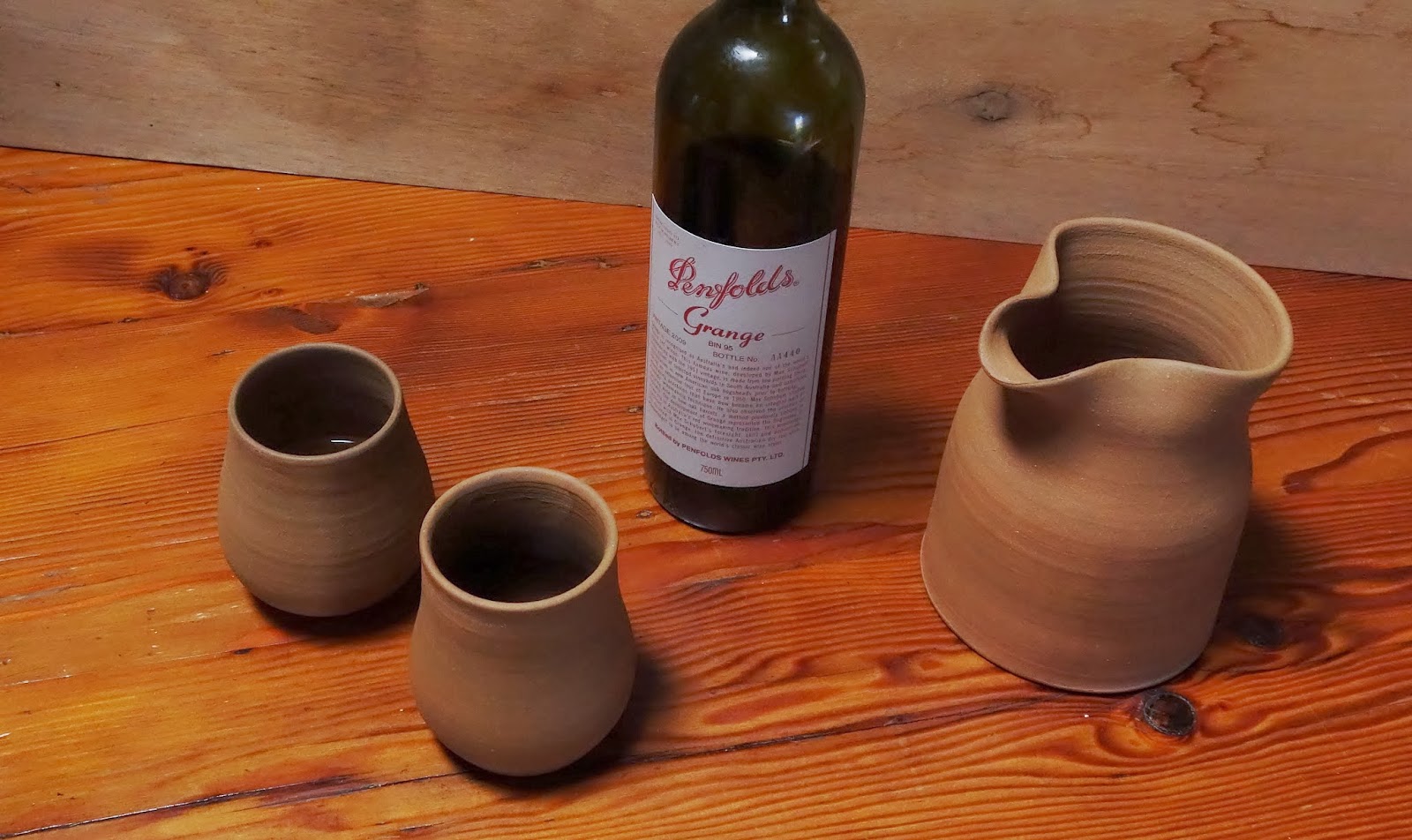
You bet exciting. By tasting vessels John refers to his beautiful wine cups and
decanting jug, which look pretty much like they belong on the table at the last
supper. His idea was that each wine should be best drunk from a cup made from
the ground it grew in.
What nobody
forecast was the incredible difference the various grounds make to wine - any
wine.
We are now
playing with the way the same wine changes dramatically in gustatory profile if
consumed from copper, pewter, stainless steel, Ironheart ground or High Sands
or the alluvial clays overlying the Kurrajong rubble under the Roussanne, which
you see being massaged today by calm, methodical human legs.
Mystified by
the range of potential reasons for the way different clays influence the
flavour of the same wine, we are now screwing around with lots of theories
about ion-exchange, surface area, iron and oxidation and Bacchus only knows
what not.
I can
guarantee one remarkable fact: the drinking cup made with ground from the Roussanne vineyard immediately softens sappy or leafy wines, imparting mellow
autumnal-rustic leather and dark charcuterie meat characters in both aroma and
flavour, almost immediately upon pouring.
In other
words, it seems to add instant years to red, without the wine losing its life
or vivacity. Leafy, wood-sappy baby American oak Cabernet, for example, is
immediately much more rounded, pleasurable and approachable, velvety and
luxurious. The new Grange just loved the clay; the old Coonawarra Cabernet I'm
trying right now doesn't need it - it's much better in the chill sanitation of
glass.
And as for the Yangarra wines?
Just for the
moment, we'll call that an industrial secret between John Ullinger and Peter
Fraser. Me? I know nuuuuuthing.
 photo Philip White