04 December 2017
WINE RIDER BY GEORGE
If you're interested in buying originals of his work, or special commissions, George Grainger Aldridge is at trojanpencil@gmail.com ... while he's currently threatening to disappear into the desert for a break, he's usually pretty quick on the draw.
29 November 2017
BEER AS WINE; SHY JEW AS SUPERHERO
Such attention to detail: everyone's talking about Schlomo Weintraub
by PHILIP WHITE
This week my in-tray oozed out a press release with a covering note from a Senior Brand Manager at Treasury Wine Estates (TWE). She introduced an outfit called Co Partnership.
It's like sooooo not today.
"Co Partnership are true brand builders," it reads. "Their naming and storytelling created relevant and engaging content for our consumer [sic], which they brought to life with such attention to detail - everyone's talking about it."
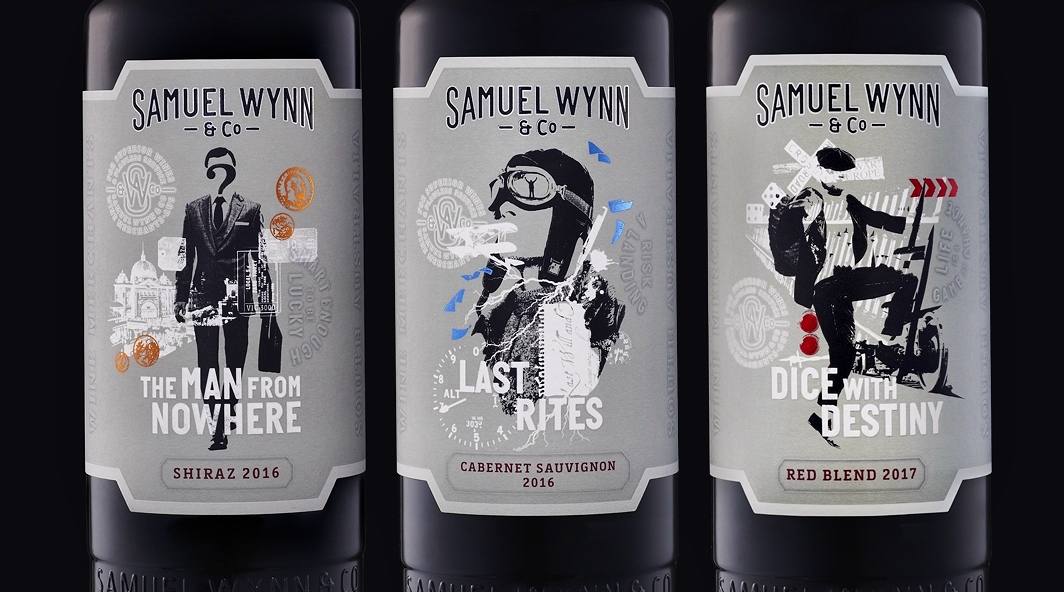
This alliance formed to launch a new brand for the TWE juggernaut: "Introducing Samuel Wynn & Co," the release says, "a new wine brand ... showcasing the stories of Samuel Wynn, founder of the iconic Wynn's of Coonawarra Estate."
Through a twisty series of sell-outs and take-overs, TWE has ended up owning Wynn's, which these folks push as a premium brand.
"Our brief was to entice a younger 'less involved' wine drinker by using the language and semiotics of craft beer, a clever strategy of recruiting cross category," the release reads.
Fair dinkum.
"By learning our consumers are 'seekers of exploration', we researched into [sic] the life and times of Samuel Wynn to uncover the stories that best captured his bold spirit. This narrative formed the inspiration for our three adventurous names; ‘The Man from Nowhere’, ‘Last Rites’ and ‘Dice with Destiny’ - with more to follow as the range grows.
"These stories inspired our filmic poster illustration style, with each label portraying scenes from Samuel’s escapades with a sense of daring and intrigue to capture the imagination. To build in more discovery, we nestled sayings amongst the illustrations that captured Samuel’s charm and personality 'Smart enough to be lucky', 'Risk & Reward’ and ‘Life is a Game of Chance’. Together these were embellished with a complex makeup of foils, embossing and high builds to provide a premium, tactile finish and catch the eye.
"With a custom designed bottle that talks to the semiotics of craft beer and a unique label shape, the complete pack works hard on shelf to differentiate against the competition with an engaging tone of voice, for the inquisitive consumer entering the world of wine."
Sorry for the huge quote, but I felt that you oughta read it all, if only to counter those who reckon I write too much bullshit. This business is brimming with it.
Notice there is not one mention of the wine all this is designed to sell.
Imagine how much Co Partnership charged the shareholders of TWE for this! Does anybody know where these grapes came from?
I was hardly a close friend of Sammy Wynn. By the time I met him he was still impeccably presented in his three-piece suit, stiff collar and French cuffs but was troubled with dementia and attended the office rarely. He died in 1982. But I knew his son David well as a friend and mentor, and became good mates with his grandson, Adam, after whom David named Mountadam.
David Wynn, Howard Twelftree and the author at Mountadam, early '90s ... photo by Adam Wynn
So for many years I was entertained first-hand by the family stories, which I have since been able to further contemplate through the annual Winegrowers' Diary written for David in the late 'sixties and early 'seventies by the great Melbourne wine critic Walter James.
David's brother Allan's 1968 biography of their father, The Fortunes of Samuel Wynn - Winemaker, Humanist, Zionist is another handy reference.
So when considering where all this adventurous intrigue and the incredible escapades come from, it was confronting to recall the Sammy I met and later learned so much about.
Sammy was a softly-spoken, fastidious Russian-born Jew from Poland. Five-foot-nothing in his socks, he wore gold-rimmed pince-nez spectacles, a bow tie and a homburg hat.
While a committed socialist and trades unionist, and eventually a staunch supporter of Zion's occupation of Palestine, he bore no resemblance whatever to the fake heroes on those Boy's Own Annual movie posters.
Sammy's real name was Solomon "Schlomo" ben David. The youngest of a humble family, he grew up dependent upon the constant pampering of domineering women: his widowed mother at first, who sold lottery tickets for a living, and his two sisters. Three bright bossy wives were to follow.
Chava Silman and Solomon "Schlomo" ben David Weintraub at their engagement in Łódź, Poland, in 1911
"All his life he was to remain dependent on women," his son Allan wrote. These were invariably "egocentric and very demanding."
The family had accepted the surname Weintraub only when the authorities of the 1800s insisted Jews adopt more conventional family names. Weintraub reflected one angle of the old family business: purchasing raisins from the Black and Caspian seas to make small batches of kosher ceremonial wine in Poland.
With his sharp intuition and fear of the nascent Germany, Schlomo saw real trouble coming to Europe's Jews. He engaged his domineering sweetheart, Chava Silman, in Łódź in 1911; they married in 1912; in 1913 they took a third-class passage to Melbourne, an uneventful trip. On arrival, there was some kerfuffle about the spelling of Weintraub, which the customs men thought must mean cooper. Sammy's terrible English was no help. So for simplicity's sake, and his delight at the opportunity of a bright new start, Schlomo ben David Weintraub became Sammy Wynn.
Right from their arrival in the colony, Sammy was delighted that there was an abundant supply of fresh grapes and plenty of wine of all types and quality. He worked as a farmhand, and then did a stint in a cork factory. With those scant savings, the few sovereigns Chava had sewn into her hem back in Poland, and some generous vendor finance, he was able to purchase a wine shop at the top of Burke Street, near the parliament. That grew into what eventually became the very famous Florentino's restaurant.
David Wynn was born upstairs there.
The wine shop, which sold much more sweet fortified out the back than premium table wine for the politicians within, took a scholarly upmarket turn in 1922 when the great Hill of Content book store opened next door. The transfusion of customers led to the growth of a bright co-operative salon atmosphere between the establishments.
While Sammy went on to build a thriving wholesale and retail wine merchant business with his son David, an empire that extended from the Yenda winery at Griffith to Romalo opposite Penfolds Grange at Magill, the firm seemed only to boom into a modern form with David's post-war influence.
An Australian Air Force man who was determined to be an architect or a sculptor, David had returned from the War with an even more refined taste for the best of Bordeaux and Burgundy.
The notion of Sammy being the "founder of the iconic Wynn's of Coonawarra Estate" is dodgy - the place was notoriously unreliable. While he'd loved buying the best of its vintages for blending and sale through his shops, Sammy never really believed the Estate could be profitable and opposed its purchase.
David always made it clear the rejuvenation of the business was his Bordeaux-inspired idea. Coonawarra was on its knees: he paid for the distillery and cellars, vineyards and other land according to the number of sheep each acre could comfortably run.
The father became the son's reluctant and longsuffering partner.
"In good years, the wine can be superb," Allan Wynn wrote in 1968. "In bad years ... it is barely drinkable."
This risk, driven by Coonawarra's inclement, frosty weather, is what eventually convinced David to sell Coonawarra and invest instead in his beloved Mountadam at the top of Eden Valley.
The huge dry-grown bush vine Modbury vineyard (see label left), whose wines were made in Edmund Mazure's old cellars at Romalo, Magill, went to the Dunstan government for suburban housing.
David launched the pioneering Burgundy-inspired Pinot and Chardonnay adventure at Mountadam in 1972. Adam became winemaker in 1984; David died unexpectedly there in 1995; then, after some poor health Adam sold it to Louis Vuitton Möet Hennessey and left winemaking forever in 2000.
Schlomo and Chava's many descendants spread across the world today. Like the actual truth about the family history, they're pretty easy to find. They tend to be a very bright, influential lot. So to ask how the Wynns reacted to images of their timid ancestor repackaged as James Bond, Biggles or some punk gambler in a beret, I made a few calls.
"No Philip, none of the family members were consulted and we are all a little bemused by the whole thing," I was told. "Someone sent a photo of the labels and initially we thought it was a joke. All a little strange really and somewhat misguided. Those stories are apocryphal at best."
Apocrypha? Now there's a name for a wine based on bullshit that talks to the semiotics of craft beer, no? But the easier lesson I'd learn from Sammy is the markup you can add if you bottle some of the flagon wine that goes to paupers out the back and sell it instead as 750ml. premium to the politicans dining at the front.
Wynns Modbury in the mid 'sixties
by PHILIP WHITE
This week my in-tray oozed out a press release with a covering note from a Senior Brand Manager at Treasury Wine Estates (TWE). She introduced an outfit called Co Partnership.
It's like sooooo not today.
"Co Partnership are true brand builders," it reads. "Their naming and storytelling created relevant and engaging content for our consumer [sic], which they brought to life with such attention to detail - everyone's talking about it."
This alliance formed to launch a new brand for the TWE juggernaut: "Introducing Samuel Wynn & Co," the release says, "a new wine brand ... showcasing the stories of Samuel Wynn, founder of the iconic Wynn's of Coonawarra Estate."
Through a twisty series of sell-outs and take-overs, TWE has ended up owning Wynn's, which these folks push as a premium brand.
"Our brief was to entice a younger 'less involved' wine drinker by using the language and semiotics of craft beer, a clever strategy of recruiting cross category," the release reads.
Fair dinkum.
"By learning our consumers are 'seekers of exploration', we researched into [sic] the life and times of Samuel Wynn to uncover the stories that best captured his bold spirit. This narrative formed the inspiration for our three adventurous names; ‘The Man from Nowhere’, ‘Last Rites’ and ‘Dice with Destiny’ - with more to follow as the range grows.
"These stories inspired our filmic poster illustration style, with each label portraying scenes from Samuel’s escapades with a sense of daring and intrigue to capture the imagination. To build in more discovery, we nestled sayings amongst the illustrations that captured Samuel’s charm and personality 'Smart enough to be lucky', 'Risk & Reward’ and ‘Life is a Game of Chance’. Together these were embellished with a complex makeup of foils, embossing and high builds to provide a premium, tactile finish and catch the eye.
"With a custom designed bottle that talks to the semiotics of craft beer and a unique label shape, the complete pack works hard on shelf to differentiate against the competition with an engaging tone of voice, for the inquisitive consumer entering the world of wine."
Sorry for the huge quote, but I felt that you oughta read it all, if only to counter those who reckon I write too much bullshit. This business is brimming with it.
Notice there is not one mention of the wine all this is designed to sell.
Imagine how much Co Partnership charged the shareholders of TWE for this! Does anybody know where these grapes came from?
I was hardly a close friend of Sammy Wynn. By the time I met him he was still impeccably presented in his three-piece suit, stiff collar and French cuffs but was troubled with dementia and attended the office rarely. He died in 1982. But I knew his son David well as a friend and mentor, and became good mates with his grandson, Adam, after whom David named Mountadam.
David Wynn, Howard Twelftree and the author at Mountadam, early '90s ... photo by Adam Wynn
So for many years I was entertained first-hand by the family stories, which I have since been able to further contemplate through the annual Winegrowers' Diary written for David in the late 'sixties and early 'seventies by the great Melbourne wine critic Walter James.
David's brother Allan's 1968 biography of their father, The Fortunes of Samuel Wynn - Winemaker, Humanist, Zionist is another handy reference.
So when considering where all this adventurous intrigue and the incredible escapades come from, it was confronting to recall the Sammy I met and later learned so much about.
Sammy was a softly-spoken, fastidious Russian-born Jew from Poland. Five-foot-nothing in his socks, he wore gold-rimmed pince-nez spectacles, a bow tie and a homburg hat.
While a committed socialist and trades unionist, and eventually a staunch supporter of Zion's occupation of Palestine, he bore no resemblance whatever to the fake heroes on those Boy's Own Annual movie posters.
Sammy's real name was Solomon "Schlomo" ben David. The youngest of a humble family, he grew up dependent upon the constant pampering of domineering women: his widowed mother at first, who sold lottery tickets for a living, and his two sisters. Three bright bossy wives were to follow.
Chava Silman and Solomon "Schlomo" ben David Weintraub at their engagement in Łódź, Poland, in 1911
"All his life he was to remain dependent on women," his son Allan wrote. These were invariably "egocentric and very demanding."
The family had accepted the surname Weintraub only when the authorities of the 1800s insisted Jews adopt more conventional family names. Weintraub reflected one angle of the old family business: purchasing raisins from the Black and Caspian seas to make small batches of kosher ceremonial wine in Poland.
With his sharp intuition and fear of the nascent Germany, Schlomo saw real trouble coming to Europe's Jews. He engaged his domineering sweetheart, Chava Silman, in Łódź in 1911; they married in 1912; in 1913 they took a third-class passage to Melbourne, an uneventful trip. On arrival, there was some kerfuffle about the spelling of Weintraub, which the customs men thought must mean cooper. Sammy's terrible English was no help. So for simplicity's sake, and his delight at the opportunity of a bright new start, Schlomo ben David Weintraub became Sammy Wynn.
Right from their arrival in the colony, Sammy was delighted that there was an abundant supply of fresh grapes and plenty of wine of all types and quality. He worked as a farmhand, and then did a stint in a cork factory. With those scant savings, the few sovereigns Chava had sewn into her hem back in Poland, and some generous vendor finance, he was able to purchase a wine shop at the top of Burke Street, near the parliament. That grew into what eventually became the very famous Florentino's restaurant.
David Wynn was born upstairs there.
The wine shop, which sold much more sweet fortified out the back than premium table wine for the politicians within, took a scholarly upmarket turn in 1922 when the great Hill of Content book store opened next door. The transfusion of customers led to the growth of a bright co-operative salon atmosphere between the establishments.
While Sammy went on to build a thriving wholesale and retail wine merchant business with his son David, an empire that extended from the Yenda winery at Griffith to Romalo opposite Penfolds Grange at Magill, the firm seemed only to boom into a modern form with David's post-war influence.
An Australian Air Force man who was determined to be an architect or a sculptor, David had returned from the War with an even more refined taste for the best of Bordeaux and Burgundy.
The notion of Sammy being the "founder of the iconic Wynn's of Coonawarra Estate" is dodgy - the place was notoriously unreliable. While he'd loved buying the best of its vintages for blending and sale through his shops, Sammy never really believed the Estate could be profitable and opposed its purchase.
David always made it clear the rejuvenation of the business was his Bordeaux-inspired idea. Coonawarra was on its knees: he paid for the distillery and cellars, vineyards and other land according to the number of sheep each acre could comfortably run.
The father became the son's reluctant and longsuffering partner.
"In good years, the wine can be superb," Allan Wynn wrote in 1968. "In bad years ... it is barely drinkable."
This risk, driven by Coonawarra's inclement, frosty weather, is what eventually convinced David to sell Coonawarra and invest instead in his beloved Mountadam at the top of Eden Valley.
The huge dry-grown bush vine Modbury vineyard (see label left), whose wines were made in Edmund Mazure's old cellars at Romalo, Magill, went to the Dunstan government for suburban housing.
David launched the pioneering Burgundy-inspired Pinot and Chardonnay adventure at Mountadam in 1972. Adam became winemaker in 1984; David died unexpectedly there in 1995; then, after some poor health Adam sold it to Louis Vuitton Möet Hennessey and left winemaking forever in 2000.
Schlomo and Chava's many descendants spread across the world today. Like the actual truth about the family history, they're pretty easy to find. They tend to be a very bright, influential lot. So to ask how the Wynns reacted to images of their timid ancestor repackaged as James Bond, Biggles or some punk gambler in a beret, I made a few calls.
"No Philip, none of the family members were consulted and we are all a little bemused by the whole thing," I was told. "Someone sent a photo of the labels and initially we thought it was a joke. All a little strange really and somewhat misguided. Those stories are apocryphal at best."
Apocrypha? Now there's a name for a wine based on bullshit that talks to the semiotics of craft beer, no? But the easier lesson I'd learn from Sammy is the markup you can add if you bottle some of the flagon wine that goes to paupers out the back and sell it instead as 750ml. premium to the politicans dining at the front.
Wynns Modbury in the mid 'sixties
24 November 2017
LONGVIEW'S NEBBIOLO TRIFECTA
An affair with the Saturno family's
triple take on four clones of Nebbiolo:
by PHILIP WHITE
Long View Adelaide Hills Nebbiolo Rosato 2017
($25; 13.5% alcohol; screw cap)
This lively fishy pink alone is good enough reason to wend your way to this picture-book Macclesfield vineyard for a platter of springtime antipasto and a glass or two while your gaze fixes itself into the middle distance and the bothers of life melt into the haze.
The noble Nebbiolo gives this bouquet a rindy blood-orange and peach allure: it's comforting and fleshy. But there's a neat spicy prickle there as well: a piquant edge that sets the anticipatory savouries gushing. The body of the wine sets up an entertaining see-saw of that homely fruity flesh dancing counterpoint to the sharper edge with its fine tannin and saucy acidity.
There's nothing simply raspberry or strawberry about this wine. It's not your simple lollypop Grenache, but a drink with its own distinction: an entertaining and delicious new benchmark in the burgeoning school of grown-up rosés for fully growed-up pinksters.
Any of the home-grown Italianate dainties on the Longview lunch card will suit it swimmingly.
Drool.
Longview Fresco Adelaide Hills Nebbiolo 2017
($36; 13% alcohol; screw cap)
I can imagine Dorothy Parker toying with a bowl of this while she dashed off a page or two of hot social bitchery for Vanity Fair or The New Yorker in the 'thirties.
The whole rockin package is uber-cool: off-the-wall use of the Bailey's bottle with jazz age graphics and a ritzy red content that goes perfectly with twenty minutes in the ice bucket while the pithy one-liners bounce about the deck.
It's spicy and sultry sniffing: Longview director Mark Saturno nails it when he suggests cherry cola. L-O-L-A Lola. Slinkin past with a cigarette holder as long as her gloves.
It's peppery and bright and zesty to inhale, but this is not built for inhaling, this is a clubby red potion for guzzling. That cherry cola thing runs all the way along the drink: it almost feels slightly petillant in its cheeky prickle. It's not mindless, but it's not going to interrupt you much. Rather, it's there to hold your chin up if you let too much of that rosato through earlier.
Dry, neat, tidy, trim: this thing's all about attitude. Massage me an olive, Boris. Sigh.
Longview Adelaide Hills Nebbiolo 2015
($50; 14% alcohol; Diam cork)
Longview's four clones of the noble northern Italian Nebbiolo have now had 22 years to own their slice of the stony Macclesfield hills. Every now and then the vintage rings loud enough for the Saturnos to release a riserva, like a king-hell dead serious mutha red.
First, this regal work hurls up spice, like nutmeg and long pepper. It really tickles the nose.
Then you get a glimpse into the depths looming below: hawthorn berries, juniper, blackcurrants, figs, dark cherries: imagine a great silver punchbowl brimming with them, soused in lemon juice and kirsch and dusted with musky icing sugar. That's your bouquet. Oh, and I must mention the bunch of roses.
Take a sip. The texture is the first thing that gets you: polished, authoritative, smooth and glinty as blue-black gunmetal. This is the boss.
The flavours are real dark and glinty, too. But there's a certain regal elegance about it: it's as much aquiline Wills as wild hairy Harry.
Like the best of upland Italian Nebbiolo, there's a unique thing about the structure of this drink. While it has all the above morass of the darker fruits in abundance, they're presented in a smooth, almost raspberry-simple and honest form, much in the manner of a more sraightfoward Pinot, like say from Morey-St-Denis.
Then, like an afterthought, oh dear, is that a fluff of tannin blowing by? And is that some neat natural acidity edging in? Oooh, I see. It's deceptive. How complex and brooding is this thing gonna get? How many decades will it glower and grow?
This is a bottle of right royal mystery.
by PHILIP WHITE
Long View Adelaide Hills Nebbiolo Rosato 2017
($25; 13.5% alcohol; screw cap)
This lively fishy pink alone is good enough reason to wend your way to this picture-book Macclesfield vineyard for a platter of springtime antipasto and a glass or two while your gaze fixes itself into the middle distance and the bothers of life melt into the haze.
The noble Nebbiolo gives this bouquet a rindy blood-orange and peach allure: it's comforting and fleshy. But there's a neat spicy prickle there as well: a piquant edge that sets the anticipatory savouries gushing. The body of the wine sets up an entertaining see-saw of that homely fruity flesh dancing counterpoint to the sharper edge with its fine tannin and saucy acidity.
There's nothing simply raspberry or strawberry about this wine. It's not your simple lollypop Grenache, but a drink with its own distinction: an entertaining and delicious new benchmark in the burgeoning school of grown-up rosés for fully growed-up pinksters.
Any of the home-grown Italianate dainties on the Longview lunch card will suit it swimmingly.
Drool.
Longview Fresco Adelaide Hills Nebbiolo 2017
($36; 13% alcohol; screw cap)
I can imagine Dorothy Parker toying with a bowl of this while she dashed off a page or two of hot social bitchery for Vanity Fair or The New Yorker in the 'thirties.
The whole rockin package is uber-cool: off-the-wall use of the Bailey's bottle with jazz age graphics and a ritzy red content that goes perfectly with twenty minutes in the ice bucket while the pithy one-liners bounce about the deck.
It's spicy and sultry sniffing: Longview director Mark Saturno nails it when he suggests cherry cola. L-O-L-A Lola. Slinkin past with a cigarette holder as long as her gloves.
It's peppery and bright and zesty to inhale, but this is not built for inhaling, this is a clubby red potion for guzzling. That cherry cola thing runs all the way along the drink: it almost feels slightly petillant in its cheeky prickle. It's not mindless, but it's not going to interrupt you much. Rather, it's there to hold your chin up if you let too much of that rosato through earlier.
Dry, neat, tidy, trim: this thing's all about attitude. Massage me an olive, Boris. Sigh.
Longview Adelaide Hills Nebbiolo 2015
($50; 14% alcohol; Diam cork)
Longview's four clones of the noble northern Italian Nebbiolo have now had 22 years to own their slice of the stony Macclesfield hills. Every now and then the vintage rings loud enough for the Saturnos to release a riserva, like a king-hell dead serious mutha red.
First, this regal work hurls up spice, like nutmeg and long pepper. It really tickles the nose.
Then you get a glimpse into the depths looming below: hawthorn berries, juniper, blackcurrants, figs, dark cherries: imagine a great silver punchbowl brimming with them, soused in lemon juice and kirsch and dusted with musky icing sugar. That's your bouquet. Oh, and I must mention the bunch of roses.
Take a sip. The texture is the first thing that gets you: polished, authoritative, smooth and glinty as blue-black gunmetal. This is the boss.
The flavours are real dark and glinty, too. But there's a certain regal elegance about it: it's as much aquiline Wills as wild hairy Harry.
Like the best of upland Italian Nebbiolo, there's a unique thing about the structure of this drink. While it has all the above morass of the darker fruits in abundance, they're presented in a smooth, almost raspberry-simple and honest form, much in the manner of a more sraightfoward Pinot, like say from Morey-St-Denis.
Then, like an afterthought, oh dear, is that a fluff of tannin blowing by? And is that some neat natural acidity edging in? Oooh, I see. It's deceptive. How complex and brooding is this thing gonna get? How many decades will it glower and grow?
This is a bottle of right royal mystery.
23 November 2017
CRACKERS FROM CAPE JAFFA
The view's much better from the edge
by PHILIP WHITE
Cape Jaffa winemaker Des Hooper went to Georgia in the Caucasus for vintage 2015.
We'd known for a long time that modern winemaking probably started there between the Black and Caspian Seas, where Europe meets Asia. Last week a group of scientists from the University of Toronto and the Georgian National Museum, funded largely by the National Wine Agency of Georgia, reported in the Proceeding of the National Academy of Sciences (USA) that they'd pushed back the earliest proven date of grape winemaking by about a thousand years into the Neolithic, 8,000 years ago.
We know the Chinese were using grapes to make alcohol a thousand years earlier at Jiahu in the Yellow Valley, but that beverage also included fermented Hawthorn berries, mead and rice wine. Chemical residues from the Georgian pots show their wine was all grapes, pure and simple.
Winery excavation at Gadachrill Gora in Georgia. Photo: Judyta Olszewski
Des and Anna Hooper were pioneering biodynamicists on the Limestone Coast: he uses the modern ceramic egg-shaped version of the ancient Georgian vessels, but experiments with fermenters and containers of many different shapes.
Their newest Cape Jaffa range, called Winemaking on the Edge, includes the following two radical trials, made with those 8,000 years of practice foremost in mind.
Cape Jaffa CJ Samphire Limestone Coast Skin Contact White 2016 ($29; 14.5% alcohol; screw cap) was made using ideas Des brought home from the Caucasus. It's a "mix of varieties we might not necessarily expect to see together" but is mainly Chardonnay. You can't tell.
The blend was fermented on skins and left on them for another six months in barrel.
Right from the start, the wine smells big and rich, perhaps along the lines of a unusually ripe Alsace white. It has, in lovely alluring harmony, syrupy hints of melting butter with shallots and rind, lime-and-ginger marmalade, rose petals and white pepper. While these are all pale items, this bouquet is as hearty and complex as many reds.
Given all that, the temptation is to serve the wine at a red temperature. This works well, but I prefer it after about twenty minutes in the ice bucket.
Its texture is as syrupy as that bouquet indicates, with flavours that turn on all my autumn leaf colours, from golden to russet. It has an earthy vegetal hint, like parsnip tails caramelised in a roast, and tapers off into very fine chalky tannins with a flavour that reminds me of that sprinkle of white pepper I sniffed at the start.
Given all that, I can't help thinking of spaghetti vongole with plenty of Italian parsley and garlic, or oilier, weed-feeding fish. Coorong mullet, flathead or leatherjackets would all work grilled or slightly smoked; a yellow curry of European carp with saffron rice would also work wondrously.
This is delicious, fascinating wine.
Cape Jaffa CJ Mesmer Eyes Limestone Coast White and Red Blend 2016 ($29; 15% alcohol; screw cap) takes its name from the German quack philosopher, Franz Mesmer, whose invention of the term "animal magnetism" covered his teaching that there's a natural energy transfer between all animate and inanimate objects.
In keeping with that transfixation, the wine is a blend of batches of Gewürztraminer, each fermented on Shiraz skins.
It's paler than full-bore dry red, and darker than any rosé, a little like the Cab Mac lighter reds Stephen Hickinbotham conjured in the 'eighties. It smells red, like raspberry, cranberry and salmonberry. But even if chilled it includes, in its tantalising bouquet, white aromas like celery, citrus pith and fresh-sliced white beets. It also has a distinctive character Hick typically, lovingly, called 'cold stew'. This includes white pepper and bay leaf.
Like the distinctive Cab Macs, it tastes somewhere between complex rosé and really savoury light red. It's vibrant and engaging and seems brightly pickled, like the best Barossa dill. Its tannin is barely there, but there's just enough to add to its piquant sharps.
The thought of a red that does well with salad is a strange notion, but this radical beauty has the perfect structure to suit a bowl of alfalfa and mung sprouts tossed in a light dressing with smoked salmon or raw - or canned - tuna, sliced dill, capers and peppery cress and/or rocket.
If you're thinking weight and texture, this is the lighter, brighter wine of the pair.
While obviously pushing today's droll boundaries, and as far removed from Jacob's Creek as Alpha Centauri, these are not unfinished or unmade hippy wines. They are both quite stable, entertaining, happy drinks, clean and tidy. They both involve a great deal more planning and design than almost everything from the murky naturalists. These two wines are complete. Accomplished. They have finesse.
Which leads me to the labels. The Spanish call labels etiquettes, after the little instructional cards newcomers were handed at court in order to know how to behave in the presence of royalty. The etiquette of wine labelling serves surely to instruct us as to what to expect in a bottle. Very handy basic information like what it is, what's in it, where it comes from and how alcoholic it might be. I'm not yet blind, but few adults with the readies to throw at unusual wines like these could ever manage to read these back label texts without bright light and major magnification. Which you won't find in a restaurant.
So: forgiven - just - for the fashionably unfinished livery, but praised to kingdom-come for daring, vision and finesse in the wine kitchen, here are two new age crackers with very very old roots that I recommend from the bottom of my thirsty, greedy heart.
Which in turn leaves me keen to see what modern Chinese winemakers will do when they forget Bordeaux and Burgundy for a century or ten and start polishing their own ancient recipes. Just take it easy on the tiger dick.
by PHILIP WHITE
Cape Jaffa winemaker Des Hooper went to Georgia in the Caucasus for vintage 2015.
We'd known for a long time that modern winemaking probably started there between the Black and Caspian Seas, where Europe meets Asia. Last week a group of scientists from the University of Toronto and the Georgian National Museum, funded largely by the National Wine Agency of Georgia, reported in the Proceeding of the National Academy of Sciences (USA) that they'd pushed back the earliest proven date of grape winemaking by about a thousand years into the Neolithic, 8,000 years ago.
We know the Chinese were using grapes to make alcohol a thousand years earlier at Jiahu in the Yellow Valley, but that beverage also included fermented Hawthorn berries, mead and rice wine. Chemical residues from the Georgian pots show their wine was all grapes, pure and simple.
Winery excavation at Gadachrill Gora in Georgia. Photo: Judyta Olszewski
Des and Anna Hooper were pioneering biodynamicists on the Limestone Coast: he uses the modern ceramic egg-shaped version of the ancient Georgian vessels, but experiments with fermenters and containers of many different shapes.
Their newest Cape Jaffa range, called Winemaking on the Edge, includes the following two radical trials, made with those 8,000 years of practice foremost in mind.
Cape Jaffa CJ Samphire Limestone Coast Skin Contact White 2016 ($29; 14.5% alcohol; screw cap) was made using ideas Des brought home from the Caucasus. It's a "mix of varieties we might not necessarily expect to see together" but is mainly Chardonnay. You can't tell.
The blend was fermented on skins and left on them for another six months in barrel.
Right from the start, the wine smells big and rich, perhaps along the lines of a unusually ripe Alsace white. It has, in lovely alluring harmony, syrupy hints of melting butter with shallots and rind, lime-and-ginger marmalade, rose petals and white pepper. While these are all pale items, this bouquet is as hearty and complex as many reds.
Given all that, the temptation is to serve the wine at a red temperature. This works well, but I prefer it after about twenty minutes in the ice bucket.
Its texture is as syrupy as that bouquet indicates, with flavours that turn on all my autumn leaf colours, from golden to russet. It has an earthy vegetal hint, like parsnip tails caramelised in a roast, and tapers off into very fine chalky tannins with a flavour that reminds me of that sprinkle of white pepper I sniffed at the start.
Given all that, I can't help thinking of spaghetti vongole with plenty of Italian parsley and garlic, or oilier, weed-feeding fish. Coorong mullet, flathead or leatherjackets would all work grilled or slightly smoked; a yellow curry of European carp with saffron rice would also work wondrously.
This is delicious, fascinating wine.
Cape Jaffa CJ Mesmer Eyes Limestone Coast White and Red Blend 2016 ($29; 15% alcohol; screw cap) takes its name from the German quack philosopher, Franz Mesmer, whose invention of the term "animal magnetism" covered his teaching that there's a natural energy transfer between all animate and inanimate objects.
In keeping with that transfixation, the wine is a blend of batches of Gewürztraminer, each fermented on Shiraz skins.
It's paler than full-bore dry red, and darker than any rosé, a little like the Cab Mac lighter reds Stephen Hickinbotham conjured in the 'eighties. It smells red, like raspberry, cranberry and salmonberry. But even if chilled it includes, in its tantalising bouquet, white aromas like celery, citrus pith and fresh-sliced white beets. It also has a distinctive character Hick typically, lovingly, called 'cold stew'. This includes white pepper and bay leaf.
Like the distinctive Cab Macs, it tastes somewhere between complex rosé and really savoury light red. It's vibrant and engaging and seems brightly pickled, like the best Barossa dill. Its tannin is barely there, but there's just enough to add to its piquant sharps.
The thought of a red that does well with salad is a strange notion, but this radical beauty has the perfect structure to suit a bowl of alfalfa and mung sprouts tossed in a light dressing with smoked salmon or raw - or canned - tuna, sliced dill, capers and peppery cress and/or rocket.
If you're thinking weight and texture, this is the lighter, brighter wine of the pair.
While obviously pushing today's droll boundaries, and as far removed from Jacob's Creek as Alpha Centauri, these are not unfinished or unmade hippy wines. They are both quite stable, entertaining, happy drinks, clean and tidy. They both involve a great deal more planning and design than almost everything from the murky naturalists. These two wines are complete. Accomplished. They have finesse.
Which leads me to the labels. The Spanish call labels etiquettes, after the little instructional cards newcomers were handed at court in order to know how to behave in the presence of royalty. The etiquette of wine labelling serves surely to instruct us as to what to expect in a bottle. Very handy basic information like what it is, what's in it, where it comes from and how alcoholic it might be. I'm not yet blind, but few adults with the readies to throw at unusual wines like these could ever manage to read these back label texts without bright light and major magnification. Which you won't find in a restaurant.
So: forgiven - just - for the fashionably unfinished livery, but praised to kingdom-come for daring, vision and finesse in the wine kitchen, here are two new age crackers with very very old roots that I recommend from the bottom of my thirsty, greedy heart.
Which in turn leaves me keen to see what modern Chinese winemakers will do when they forget Bordeaux and Burgundy for a century or ten and start polishing their own ancient recipes. Just take it easy on the tiger dick.
21 November 2017
GRENACHE FROM DOMAINE MARCOUX
The author, Pierre-Henri Morel, Joel Mattschoss, Peter Fraser and Michael Twelftree
Grenache from the south of France to South Australia: an intimate trip
by PHILIP WHITE
It was one of those special tastings where one gets a chance to gaze over somebody's fence. Perhaps the best example of Experiential Tourism. Have a quiet look into several decades of one family's distinctive contribution to Grenache.
Barossa Two Hands man Michael Twelftree raided his own cellar and tabled a string of great vintages from the famed Armenier sisters, Sophie and Catherine, of Châteauneuf-du-Pape. Watching the way the Armeniers changed the direction of the old family estate is a real intimate, dead honest treat. After brother Philippe moved to the Napa and winemaker Sophie and business manager Catherine secured complete control of the company in 1996, you can see the brand finding its cult through consistence and sensitivity in vineyard and winery. This tour of the highlights of their scarce grail, their Domaine Marcoux Vieilles Vignes, from 1990 to 2015, was like opening somebody else's mail: it is that private.
Sophie and Catherine Armenier
They make only about 300 cases a year of Vieilles Vignes, from three of the best of their priceless suite of little vineyards. The sisters farm incredible 50-100+ years bush vine Grenache biodynamically a few kilometres from the Rhône. Their family, originally called Armani - no not the Italian lot - were well-established in this south-of-France district in the register of 1344. They were probably there before any popes came fleeing from Italy. The calcerious geology supported that little village of lime-burners so well it was called Châteauneuf Calcernier dit de Pape until 1893.
When I consider the limestone and calcrete, and the red and paler clays of McLaren Vale, I feel certain this Austral district could go very damn close to replicating the riverine alluviums of Châteauneuf. Then the Kurrajong Formation of the Willunga Faultline and its escarpment often reminds me of bits of the Rhône delta, before it was washed to riverine roundness. It's been a long time since a stream with the force of the Rhône came out of the Mount Lofty Ranges. Instead, the Vales has the recent wind-blown æolian sand of Blewett Springs and Kangarilla atop much of its clay. Yum-o.
And I'm not being an antipodean smartarse when I say the range of modern winemaking technologies well established in the best of McLaren Vale leaves most of Châteauneuf for dead. There, a vast amount of the vintage is fermented and matured in open concrete vats and big old skanky oak the like of which most of the Vales left behind in the 1970s and 80s.
Relentless winehound Dr Bob - Robert de Bellevue MD - from New Orleans, with Yangarra Estate/Hickinbotham Clarendon Vineyard manager/chief winemaker Peter Fraser and an experimental stainless steel temperature controlled amphora ... photo Milton Worldey
To be fair, the great makers of those days, like d'Arry, Jim Ingoldby, Reynella and Seaview, were quite capable of using old kit like that to make Grenache very much akin to the top of today's Mediterranean France. And Spain.
Michael Twelftree brought his wines south from the Barossa with his Two Hands General manager, Pierre-Henri Morel, who worked for M. Chapoutier on the Rhône for thirteen years before starting at Two Hands as Sales and Marketing Director in 2014. Joel Mattschoss, Wilton Hill Vineyard proprietor with probably Australia's highest Grenache at 525 metres up on Mengler's Hill in the Barossa Tops came too. Yangarra Estate boss Peter Fraser made us welcome in the White House on Hickinbotham Clarendon Vineyard. He brought Yangarra High Sands Grenache 2010 and '15; we also tasted a few of the recent popular prize-winners from the Barossa and McLaren Vale.
The Marcoux wines were such open-hearted, honest reflections of Grenache from a particular spot with such a grand old culture that as I say, tasting them seemed to involve the presumption of an intimate trust. They showed how very special Grenache is often unique for the disarming human-ness of its flesh. Which is probably why we like it. From pink bubby flesh to great powdered Rubensian folds, it can can all seem deliciously human at its best.
Even my tasting references to pork belly or carcuterie meats, Nivea or tack dressing, cream and cherry gel all offer fairly thin drapes over the simple honest humanness of Grenache made with so much love that itself can degrade to simple obsession at the cost of due respect.
Which is not what happened here: We could see Sophie locking her winemaking in through 2000 and '03, gathering pace in '04 and '05, then really changing gears with the tight clean precision of '07. Then the '12 was even more so, racy and fresh with the thrill of speed and risk. To which I must have made a motoring rather than anthropophosical reference. Our colleague M. Morel made a remark about the profile of your average new age Châteauneufer in suggesting that while there are plenty of Lamborghinis crammed in the little burgh's laneways, he'd never seen one in a vineyard.
"But it's the biggest car show in Europe some weekends," he said.
Somewhere in there lies the thing about Grenache. You can make it low and fast or cushy and luxurious; carbon fibre and titanium or plush old leather and rivets but in both extremes the sins are like totally carnal and indulgent. Much more so, I suggest, than Pinot, which is more acidic and tannic.
McLaren Vale Grenache is low in acid and tannin, but also has a low pH, which lessens the need for their preservative role. At the risk of contradicting myself and committing heresy, I continue however to dare McLaren Vale makers to nevertheless pick some of it earlier and learn to make it in accordance with that extra elegance at the risk of shedding some pounds in the flesh division.
Yangarra and Hickinbotham Clarendon estates viniculturer Michael Lane under attack from an ancient Grenache vine that didn't take too much of a liking to the look of his pruning snips ... photos by Philip White
I daren't go so far with Barossa Grenache, however. I don't
understand the harsher, drier tannins there, arising I suspect from the
region's lower background humidity. The moistening, softening influence of Gulf
St Vincent is the key to McLaren Vale. Moisture, see? Geologies repeat
everywhere.
So, what's best? Locally, we need now to remember what we lost, and nearly lost forever in our national desertion of Grenache when the cool climate Cabernazis and Chardonneighs took over.
McLaren Vale in particular was making more wines along the lines of these gorgeous Domaine de Marcoux delights in the 'seventies than it does now. At the same time, wines like Kay Brothers' two recent trophy-winners, including the Bushing King crown, show some have never stopped doing it with long-distance love, stoic determination, and an admirable disdain of the fashion of the day. .
The wine coming from Yangarra and Twelftree/Two Hands is another thing again. They're gently edging some reinforcing science into this very old, mystifying intrigue. It is this sort of modern intelligence which drew Pierre-Henri Morel to Australia.
Grenache from the south of France to South Australia: an intimate trip
by PHILIP WHITE
It was one of those special tastings where one gets a chance to gaze over somebody's fence. Perhaps the best example of Experiential Tourism. Have a quiet look into several decades of one family's distinctive contribution to Grenache.
Barossa Two Hands man Michael Twelftree raided his own cellar and tabled a string of great vintages from the famed Armenier sisters, Sophie and Catherine, of Châteauneuf-du-Pape. Watching the way the Armeniers changed the direction of the old family estate is a real intimate, dead honest treat. After brother Philippe moved to the Napa and winemaker Sophie and business manager Catherine secured complete control of the company in 1996, you can see the brand finding its cult through consistence and sensitivity in vineyard and winery. This tour of the highlights of their scarce grail, their Domaine Marcoux Vieilles Vignes, from 1990 to 2015, was like opening somebody else's mail: it is that private.
Sophie and Catherine Armenier
They make only about 300 cases a year of Vieilles Vignes, from three of the best of their priceless suite of little vineyards. The sisters farm incredible 50-100+ years bush vine Grenache biodynamically a few kilometres from the Rhône. Their family, originally called Armani - no not the Italian lot - were well-established in this south-of-France district in the register of 1344. They were probably there before any popes came fleeing from Italy. The calcerious geology supported that little village of lime-burners so well it was called Châteauneuf Calcernier dit de Pape until 1893.
When I consider the limestone and calcrete, and the red and paler clays of McLaren Vale, I feel certain this Austral district could go very damn close to replicating the riverine alluviums of Châteauneuf. Then the Kurrajong Formation of the Willunga Faultline and its escarpment often reminds me of bits of the Rhône delta, before it was washed to riverine roundness. It's been a long time since a stream with the force of the Rhône came out of the Mount Lofty Ranges. Instead, the Vales has the recent wind-blown æolian sand of Blewett Springs and Kangarilla atop much of its clay. Yum-o.
And I'm not being an antipodean smartarse when I say the range of modern winemaking technologies well established in the best of McLaren Vale leaves most of Châteauneuf for dead. There, a vast amount of the vintage is fermented and matured in open concrete vats and big old skanky oak the like of which most of the Vales left behind in the 1970s and 80s.
Relentless winehound Dr Bob - Robert de Bellevue MD - from New Orleans, with Yangarra Estate/Hickinbotham Clarendon Vineyard manager/chief winemaker Peter Fraser and an experimental stainless steel temperature controlled amphora ... photo Milton Worldey
To be fair, the great makers of those days, like d'Arry, Jim Ingoldby, Reynella and Seaview, were quite capable of using old kit like that to make Grenache very much akin to the top of today's Mediterranean France. And Spain.
Michael Twelftree brought his wines south from the Barossa with his Two Hands General manager, Pierre-Henri Morel, who worked for M. Chapoutier on the Rhône for thirteen years before starting at Two Hands as Sales and Marketing Director in 2014. Joel Mattschoss, Wilton Hill Vineyard proprietor with probably Australia's highest Grenache at 525 metres up on Mengler's Hill in the Barossa Tops came too. Yangarra Estate boss Peter Fraser made us welcome in the White House on Hickinbotham Clarendon Vineyard. He brought Yangarra High Sands Grenache 2010 and '15; we also tasted a few of the recent popular prize-winners from the Barossa and McLaren Vale.
The Marcoux wines were such open-hearted, honest reflections of Grenache from a particular spot with such a grand old culture that as I say, tasting them seemed to involve the presumption of an intimate trust. They showed how very special Grenache is often unique for the disarming human-ness of its flesh. Which is probably why we like it. From pink bubby flesh to great powdered Rubensian folds, it can can all seem deliciously human at its best.
Even my tasting references to pork belly or carcuterie meats, Nivea or tack dressing, cream and cherry gel all offer fairly thin drapes over the simple honest humanness of Grenache made with so much love that itself can degrade to simple obsession at the cost of due respect.
Which is not what happened here: We could see Sophie locking her winemaking in through 2000 and '03, gathering pace in '04 and '05, then really changing gears with the tight clean precision of '07. Then the '12 was even more so, racy and fresh with the thrill of speed and risk. To which I must have made a motoring rather than anthropophosical reference. Our colleague M. Morel made a remark about the profile of your average new age Châteauneufer in suggesting that while there are plenty of Lamborghinis crammed in the little burgh's laneways, he'd never seen one in a vineyard.
"But it's the biggest car show in Europe some weekends," he said.
Somewhere in there lies the thing about Grenache. You can make it low and fast or cushy and luxurious; carbon fibre and titanium or plush old leather and rivets but in both extremes the sins are like totally carnal and indulgent. Much more so, I suggest, than Pinot, which is more acidic and tannic.
McLaren Vale Grenache is low in acid and tannin, but also has a low pH, which lessens the need for their preservative role. At the risk of contradicting myself and committing heresy, I continue however to dare McLaren Vale makers to nevertheless pick some of it earlier and learn to make it in accordance with that extra elegance at the risk of shedding some pounds in the flesh division.
Yangarra and Hickinbotham Clarendon estates viniculturer Michael Lane under attack from an ancient Grenache vine that didn't take too much of a liking to the look of his pruning snips ... photos by Philip WhiteSo, what's best? Locally, we need now to remember what we lost, and nearly lost forever in our national desertion of Grenache when the cool climate Cabernazis and Chardonneighs took over.
McLaren Vale in particular was making more wines along the lines of these gorgeous Domaine de Marcoux delights in the 'seventies than it does now. At the same time, wines like Kay Brothers' two recent trophy-winners, including the Bushing King crown, show some have never stopped doing it with long-distance love, stoic determination, and an admirable disdain of the fashion of the day. .
The wine coming from Yangarra and Twelftree/Two Hands is another thing again. They're gently edging some reinforcing science into this very old, mystifying intrigue. It is this sort of modern intelligence which drew Pierre-Henri Morel to Australia.
20 November 2017
Subscribe to:
Posts (Atom)


