“Sod the wine, I want to suck on the writing. This man White is an instinctive writer, bloody rare to find one who actually pulls it off, as in still gets a meaning across with concision. Sharp arbitrage of speed and risk, closest thing I can think of to Cicero’s ‘motus continuum animi.’

Probably takes a drink or two to connect like that: he literally paints his senses on the page.”


DBC Pierre (Vernon God Little, Ludmila’s Broken English, Lights Out In Wonderland ... Winner: Booker prize; Whitbread prize; Bollinger Wodehouse Everyman prize; James Joyce Award from the Literary & Historical Society of University College Dublin)


.

.

.

.
Showing posts sorted by relevance for query Castagna. Sort by date Show all posts

07 May 2013

CASTAGNA VIBRATES UNDER A FULL MOON


As good as wine tasting gets
Genesis from then to now
And tasted on a root day!
by PHILIP WHITE   

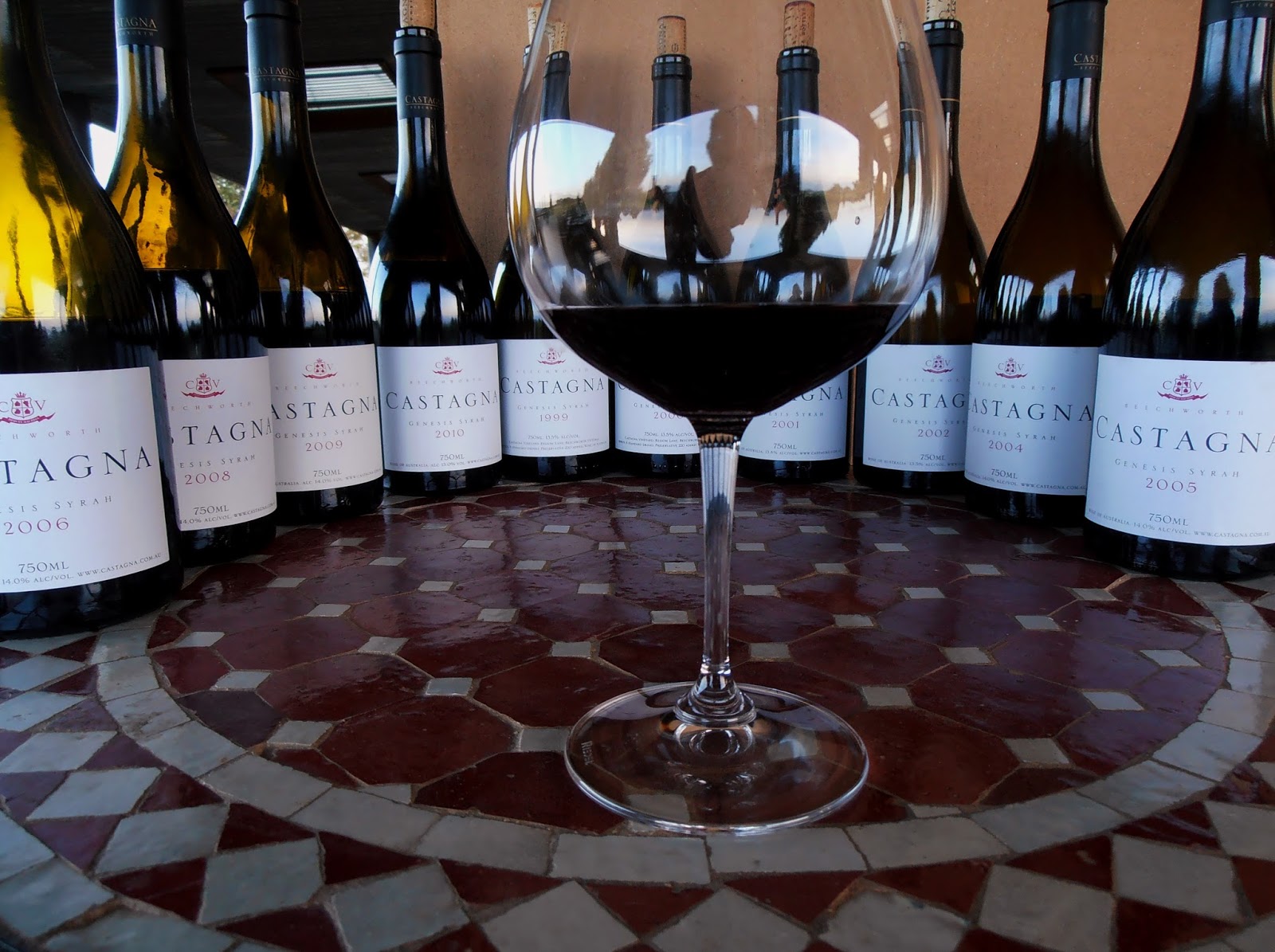
Away back on the other side of last vintage I sat down at the laden table of the Castagna family at Beechworth, on the northern foothills of the Victorian Alps. To me, this is as good as wineries get.  While I think about thirty of Australia’s 2600 wineries make consistently brilliant wine, Castagna is as close to the top of that thirty as I would care to measure.

Or could measure.

No need to remind my long-term readers how I feel about stuff like that.  But for those who came in late, a tasting like this at Castagna is such a flash of stately brilliance that I wish I had to walk home from Rome across China to Shanghai or somewhere, just to fully digest these notes.

Julian and Adam Castagna first gave me a tasting of barrels.  2012 Shiraz in a new Burgundy barrel? Creamy, creamy in the mouth; crème de cassis; sublime intensity and elegance.  Finish?  Pickle of granite in acid and mace.

Same wine in a Bordeaux barrel? Still creamy, but much more austere and precise: pencil shavings and more gradually tapered, like Bordeaux.

Same wine in old barrel?  More like the most soulful of Castagna.  And on we went.  Same vineyard picked eight days later with one per cent more alcohol in a new Burgundy barrel?  Another beast again.  This was architecture more than cooking, the most precise shard of a wine, agro allspice, sandy smashed windscreen tannins.  Gehry.  “I’d never use Bordeaux oaks on stuff this strong,” Julian said.  Same wine in a barrel from another Burgundy cooper?  The wine’s much more pungent, sick and creamy on the one hand, yet as edgy as wet hessian or burlap or the wheatbags of hemp seed we could get at Charlicks in the seventies.  It was called Racing Pigeon Food.

So there we went, on through the dancing mysteries of Castagna Sangiovese and Nebbiolo in different oaks – trippy – and right to the verge of one of the most exciting tastings this writer can remember in Australia or anywhere: a serious uncorking of a set of Castagna Genesis Beechworth Shiraz, and a day to wallow in them.

My first contact with the Castagna occurred when the 1999 Genesis poked its noble head from a row of hundreds of glasses of masked Shiraz and ended up winning the highest points out of the thousands of everything tasted for the 2001 Top 100 in The Advertiser, South Australia's major daily.  For consecutive years thereafter, Castagna repeated the conquest with one wine after another.  Blind tastings; wines I’d never tasted before.  They kept winning.


Carolann Castagna (gardener, viticulturer, researcher and writer), sons Alexi (film-maker) and Adam (winemaker), and Julian Castagna (padrone)  with respective hounds on their veranda ... all these people are sublime cooks ... photo Philip White

.
So here’s that wine again.   

Castagna Genesis Beechworth Shiraz 1999 (13.5% alcohol; 96++ points).  “Not like any other Australian Shiraz,”  I scratched out.  “creamy, opulent, luxurious, harmonized essence of Shiraz, almost leaden in its incredible authority and weight.  The fruit simply melts into a pot of red gold.”  And then Julian butts in.  “This is off two year old vines,” he says.  “I took one bunch off every vine.  That’s all.  That’s all.  I think you’ll see that these wines are of this vineyard,’ he says.  “Of this vineyard.”

Castagna Genesis Beechworth Shiraz 2000 (13.5% alcohol; 95 points) shares the 1999s creamy wholesomeness, but it’s sharper in the herbals.  If the oak contributed any precise aroma to the ’99, it was mace, made from the peel of the nutmeg.  This is the nutmeg itself here in this 2000.  While still smooth and harmonious, this wine has feints of soot, licorice and star anise.  It’s more slender and sinewy, vivacious and bright than the ’99, and the better one to drink now, as it won’t last as long as that venerable.

Castagna Genesis Beechworth Shiraz 2001 (13.8% alcohol; 94+++ points)  smells like a three-year old wine.  It reminded me of Gago’s rad Bin 620 Penfolds, with all that brash confidence and luxurious intensity way beyond its short years.  I’m not saying it’s aged prematurely, but that it has adult flesh of the finest athletic form far too early for its own good.  And I'm begrudging in this praise.  It seemed as slender and athletic as the 2000, but then with air made itself more so, with more sinuous, snaky acidity and finer tannins.  A most refined and elegant wine on any table. And another one sure to swell with a decade of dungeon.

Castagna Genesis Beechworth Shiraz 2002 (13.5% alcohol; 96+++ points)  had more of a pronounced dried herbs touch than its predecessors.  It’s also minty, like peppermint, and impossibly youthful and bright.  It’s fruit is still fluffy, like a whipped confection.  Call me your little whipped confection if you like, as long as you tip this into me.  As it settles its minions onto the prairie of the palate, it brings a hint of chocolate
crème caramel from a great city restaurant many horses distant.  There is no other Shiraz like this. Astonishing.  Ravishing.

Castagna Genesis Beechworth Shiraz 2003
was not released. The vintage was not up to standard.

Castagna Genesis Beechworth Shiraz 2004
(14% alcohol; 93+ points) is where the
crème de cassis, the jujube fruits, licorice and star anise well together in a sullen sort of a well, giving nuffink away until you get it onto the laughing gear, where all the above are liberated very slowly, like one hostage at a time, surrounded by and scribbled upon by the heavy lead of the 6B carbon pencil.  The wine is slightly hot from its alcohol.  Profound and confounding.  Its heavy lack of primary humour reminds me of Dorris Lessing, but its fine silky tannins draw it out to a prime tension probly beyond Dorris.

Castagna Genesis Beechworth Shiraz 2005 (14% alcohol; 93+ points).  Oooh dear.  Musk, blackberry, blackcurrant, jujubes, jello, lipstick, tea tin, dried herbs, mace, bay, star anise, cedar, licorice, Marveer … and then, dammit, it smells like a clarinet!!!!!!!!!  Not the most intense, but one of the most entertaining of the Genesis suite.  The alcohol’s not particularly hot, but because the rest of the wine is more slender, with lower fruit levels, that 14% still seems overt here.  Answer?  Wait five years.  Or pretend it’s an oboe. Whatever it is, and whatever I think, will be two very different things once you have a wine like this in your glass.  It will take your heart away.

Castagna Genesis Beechworth Shiraz 2006 (14% alcohol; 96+++ points)  is probably one of the great Shiraz wines of history. Anywhere. After many hours of air, it still begrudgingly begins to release shards of fruit of impenetrable depth and compression.  It has the usual mace and anise and whatnot, but in a wine of this promise and provenance, who gives a damn? Everything else is here, so why not them? The only disconcerting thing is the tension of its compression: it’s like my buddy George Grainger Aldridge folding his vast frame into an economy seat.  There’s a pallet of this put aside somewhere.  I hope they keep it buried for another decade, at least.  It reminds me of the  Paul Jaboulet Ainée 1961 La Chappelle Hermitage.


Castagna Genesis Beechworth Shiraz 2007 was not released. The vintage was not up to standard.

Castagna Genesis Beechworth Shiraz 2008 (14% alcohol; 94+++ points) is heavy metal.  Death metal.  I know of few wines so strangely, deliciously metallic.  It is welder’s flux, with the phosphoric acid of Coca Cola gnawing away at the blood pudding away below.  Not swearing it’s there, but you get my drift.  Juniper berry tannin.  Then there’s a range of fleshy flavours which kinda swoop in heroically like the Valkyrie or something off a Wagner single.  Sabayon, fudge, chocolate crème caramel are suddenly there as cushioning agents.  Come, sweet agents, cushion me!  Which all should serve to warn you that this wine needs to be left snoring for a decade more.  Very black magic.

Castagna Genesis Beechworth Shiraz 2009 (14% alcohol; 95+++ points) is a softer, more fleshy wine from the hellfire and brimstone of a vintage which saw many dead across the Alps of Victoria.  While the flavours are much tighter and more sinuous than the bouquet would indicate, with blacksnake acid and blackdust tannins, there’s a wallow of softer, much more cuddlepot fruit over the top, making the wine remind me of Welcome To Woop Woop.  This is the most approachable Genesis of the more recent  years. Which is never to say it’s a pushover.

Castagna Genesis Beechworth Shiraz 2010
(13% alcohol; 96+++ points) The time for rewriting is past.  “Impossible to understand,” my notes verbote, “at this its obscene zygotic mystification.  Face cream.  Blackberry leaf.  Carbon and black granite. Tourmaline.  Totally barren of sensuality and flesh. Gunbarrells.  Not one skerrick of humour.  NOT FUNNY AT ALL.”

So let that be a lesson to you.  My advice is NEVER miss a tasting of Castagna Genesis or anything else from that bonnie vineyard up on the rocky shoulder of Australia itself.  Just buy the wine and put it away and hope you don’t die too fast.  It is indeed about as good as we get from single vineyard Shiraz.  On Earth. 


If you think I’m wrong, there’s only one reason I can think of.  We did this tasting on a root day.  Fair dinkum.  A root day. We miscalculated.  Too much Full Moon.

11 November 2011

CASTAGNA OPENS TO FALCONS & THUNDER

CAROLANN, ALEXI, ADAM AND JULIAN CASTAGNA photo PHILIP WHITE

A Trip Into Parfumiers' Heaven
Tricky Sonnet Tension Of Wine
Miracle Tasting In Kelly Country

by PHILIP WHITE

The Castagna family of Beechworth, in the mountainous Kelly country of northern Victoria, open their winery for tasting just one day each year. Having been smitten from afar by the glory of their exquisite biodynamic works for ten vintages now, I finally got my bad arse up the mountain to their vineyard and winery to taste and sniff everything in the one breezy stretch. Beechworth is a hard place to arrive at if you don’t drive a car, so the masterly Satanika took the tiller, all the way up the Hume, and when we got there, one day turned into many: I reveled in the wonder of it all.

But it started in a deadly bar in Melbourne.

There’s a hyper-cool vodka joint in Brunswick Street Fitzroy called Naked For Satan. It’s where Leon Satanovich set up his sly grog stills between the wars: they’ve all been moved upstairs now, and deck the rooms like ghostly alchemist relics; a sort of bubblin’ and troublin’ William Heath Robinson bootleg nightmare. Somebody found a photo once which some think might be Leon; that's it below. So you stand in this strange copper refinery and examine glass after glass of the specialty flavoured vodkas they make by steeping real fresh fruitaveg – chilli, ginger, watermelon, ly-chee etc. - in Absolut. While I’d prefer Finlandia for the steeping – it’s cleaner - I went on to double my delight in discovering that the vodka da dayskovich was Żubrówka.

This delicious Polish spirit is distilled from rye, and is infused before and during bottling with buffalo grass - Hierochloe odorata – or a tincture made from it. As the label quaintly points out, this is “the grass much beloved by the Polish Bison”. The European bison’s really called the żubr, so the stuff’s called Żubrówka. I imagine they’d probably eat rye, too, but it seems like a fool for his dope the poor old żubr just can’t walk past a blade of Hierochloe odorata.

Similarly, I find it pretty hard to walk past a bottle of Żubrówka - each bottle comes fitted with a blade of the voodoo greenery. I can’t find an Australian buffalo grass that smells as sweetly of vanilla bean, vetiver and perhaps ripe Rocha pear as this Polish model. But the moment I opened the car door at the gate of Castagna Vineyard, in the lee of my Żubrówka hangover, my nostrils caught a wave of it so sweet and thick it took me straight back to Poland. I nearly grew some cloven hooves.

Just as the highly volatile oil of eucalyptus blows through the air to settle on the blume of grape skins, imparting the overt eucalypt aroma often confused with mint and menthol, so does the breath of many herbs and grasses, each carrying their unique aromatic signature. Lavendar is oily, violets, too, and fennel. These all flavour grape skins. But it’s complex: the rank onion weed easily influences grapes hanging above. The human hooter can detect some of these compounds in parts per trillion, so you don’t need much on your grape to severely alter the aroma of your wine.

FRESH MEADOW SWARD AT THE BEGINNING OF WINTER ... CASTAGNA VINEYARD, 500 METRES TALL IN THE SANDSTONE AND GRANITE AT BEECHWORTH, NORTH-EASTERN VICTORIA photo CASTAGNA

At 500 metres, the Castagna vineyard offers a straight eyeline to Mt Buffalo a thousand metres above to the south. It is high and breezy, and in spite of the ungiving stone shallow below, the sward is so thick with alpine grasses and herbs that they must unequivocally influence the nature of the finished wine. I sniffed many of the individual grasses, but betwixt thunderstorms I couldn’t find that one single blade that reeks of the Żubrówka bottle. Maybe it’s there, still waiting to be found; maybe when I alighted the car I smelled an aromatic amalgam of all sorts of grasses, dampened by a sunshower and sensorily lit up by the ozone of lightning and the wild nitrogen it activates. Carolann Castagna was busy collecting seeds from her herb garden next day; she throws these about the vineyard to maximize the complexity of the healthy sward there. But let me assure you, that mysterious character plays a very important part of the aromatic and flavour structure of the Castagna wines.

Which is never to say these things dominate. Let’s just say they are a part of the inextricably complex web of influences which all have their input into these delicious wines … from the granite and sandstone below to the stars above, these Castagnas are always some of the most beautiful drinks in Australia.

To keep his rigourous quality standards high, Julian Castagna has decided to release no 2011 wines from the Castagna vineyard. It’s a pity more winemakers who masquerade as premium producers haven’t shown similar honesty about the mess of the second wettest vintage in Australian winemaking history.

At Castagna, former film director Julian is winemaker. His partner, the writer and researcher Carolann, runs the vineyard with their son Adam, who also makes the Adam’s Rib wines, sometimes using fruit bought from vineyards up the road. Alexi, another son, is a cinematographer. All these people, and their spouses and friends, are obsessive gastronomes. You don’t stand between a Castagna and its stove, and you stand well back when the corkscrew’s twirling. Respect.

JULIAN CASTAGNA PORTRAIT BY WARWICK WOOD photo PHILIP WHITE

Castagna Adam’s Rib The White 2008

$35; 14% alcohol; Diam cork; 93+++ points
This wine, made by Adam Castagna, set an attitude that ran right through this tasting on the veranda. First, this style depends upon an accurate reflection of the sweet aroma of the meadow grasses of the property. Secondly, the wines seem built around a tensioning spring which slows the entertaining see-saw of flavours and aromas that comfort and soothe on the one end, and titillate and provoke on the other. To manage both sensations smoothly and harmoniously would seem impossible if not plain unlikely, but like the spring of sense that sets the tension in a sonnet, holding you to it, there’s a perfect tension that addicts you to this glass. The smoothing parts of it – it’s a Chardonnay Viognier blend – are fleshy. In this opulent wine, that sweet vanilla-like meadow grass approaches crème caramel in fleshiness. And there’s the smell of cantaloupe and prosciutto: it’s all comforting, reassuring and calming. Then that beautiful mountain-fresh natural acidity flicks a switch, and the sharp vivacity turns up with whiffs of dust and fresh-split sandstone: an acrid edge that tickles the nose hairs with desert smells of such clarity that I found myself dreaming the soundtrack of The Good, The Bad, and The Ugly.

CCastagna Adam’s Rib The White 2009
$35; 14% alcohol; Diam cork; 94+ points
Immediately more tropically fruity, the younger Rib has flesh of pineapple, jackfruit, cantaloupe and prosciutto, even honey. It’s sumptuous and lush. Then, riding on the sweet ripe meadow aroma, comes dust and burlap, and the acrid peel of that cantaloupe. That comfort and titillation see-saw’s there again, perhaps even more blatantly: amongst all those yellow fruits and melons, this still has that bright acid zap, if you can get a gradual zap. It’s tantalizing. Adam says he gave it more skins and a tiny slop of Roussanne from up the road.

photo CASTAGNA

Castagna Ingénue Beechworth Viognier 2010

$55; 14% alcohol; Diam cork; 95+++ points
As tight as a kettle drum, this wine of Julian Castagna is as drawn and taut as it is suave and elegant. It’s wired as well as sprung, immediately more acrid and sharp: almost brittle. It prickles the nostrils. I found myself thinking of the smell of Sir Arthur Streeton’s Fire’s On – Lapstone Tunnel 1891 and finally realized that the piquant sandstone country around Castagna is pretty much the country that young Arthur painted as the navvies and powdermonkeys drove a train line through the mountains just the other side of the border and up a bit. Fortunately, they didn’t have to go through the granite also resident at Beechworth. With this wine, the air within my glass smelled the same as the air without. Then, once again, beside the dust and the sunbleached hay, that sweet fleshy grass insinuated itself, this time as cool and cucumbery as Issye Miyake. By Bacchus, it’s a beautiful drink. Those triple-x phenolics dance round in the acid like William Burroughs does when he takes off his skin for his bone dance, and yet there’s still that swoony, comforting, luxurious Żubrówka flesh. Peking duck.

Castagna Allegro Beechworth Syrah Rosé 2010
$30; 14% alcohol; Diam cork; 95++ points
This is like one of those people who radiate such cornflower-blue health that they make you feel sick. It’s riddled with well-being: watermelon, pomegranate, raspberry … and I was just about to switch over through the blood orange and its pith to the bone china tannin when the dry edge was violently installed by a falcon whacking into a juvenile Wattle Bird on the veranda behind me. When I asked why the little bird was trying to get into the bedroom they explained it had just escaped the talons of a hungry demon from the blue, but didn’t tell me because it was all over in a flash. That’s the first time that’s ever happened in my immediate vicinity in the middle of a wine appraisal. You don’t get raptors in vineyards managed under the old petrochem regime. When you use poisons, you get sick insects. Sick insects mean sick birds and snakes, and sick birds and snakes means dead raptors, as they’re the end of the food chain. Nothing sick about that hungry, heaving falcon. Anyway, once I got the feathers outa my carby I realized that this wine has a delicious bitterness which is almost along the lines of a Campari with soda, and while its acid might seem a tad brittle it actually slithers round one’s gustatory stage like a viper. These rosés of Julian’s are always pretty much the best in the country: out of thousands of entries, the 2001 Allegro was outright winner of all classes in my Top 100 in 2002; the only time a rosé ever rose to such heights.

photo PHILIP WHITE

C
astagna Adam’s Rib The Red 2008
$35; 14% alcohol; Diam cork; 94+++
Nebbiolo and Syrah. Moody, glowering, simmering and surly down below, acrid and almost irritating up top. As it settles, it suddenly seems perfectly assimilated and cool, and all that marello cherry and blueberry seems rich and opulent, and suits perfectly the velvet tannins that fur up its tail. Then the acid announces itself, and sets the whole thing flowing with sinuous, silky syrup that makes me really friggin hungry. These various wings of the wine seem to take turns to hold you, and it, aloft. But I expect great Nebbiolo to also set its tannin loose above its palate, like a cloud; an ethereal, heavenly mattress of fluff. While this wine certainly holds me suspended, it has not quite set its tannin free: it’s still there at the bottom of the mouth, growling like a caged Shiraz. But it’s stunning wine nevertheless, and amongst the best use I’ve seen of the confounding prehistoric Nebbi in this confounding prehistoric land. Adam is a winemaker to watch!

Castagna Adam’s Rib The Red 2009

$35; 13.5% alcohol; Diam cork; 93-4+++ points
Because of its braw infant structure, this wine is too young to point: the wise appraiser should withdraw from limiting its bright potential with numbers. It is more intense and taut than the 08; more austere and unformed. It has rude blueberry in abundance, but where the older wine has marello cherry, this has acrid juniper riding shotgun, and it has aniseed and licorice where the 08 has other fleshy fruits. The palate has staunch Protestant astringency, tannin and acid. I should think my next appraisal should be in about 2020, by which point some of the Nebbiolo’s puppy fat will have gained a grasp of these hard black Shiraz bones.

ADAM CASTAGNA PRESENTS HIS WINE AT THE ANNUAL TASTING DAY photo PHILIP WHITE

Castagna Un Segreto Beechworth Sangiovese Syrah 2009

$75; 14% alcohol; Diam cork; 92-3+++ points
Extreme elegance; extreme concentrate. Slender, intense and snaky; harsh with swarf and blackwood. Syrupy with essence of coffee and chicory; dry and tannic like black tea leaves. Blueberry and blackcurrant gels in dark chocolate; the whiprod acidity of the fencing foil. Once again, it’s all attack and feint, parry and plunge, and this back-and-forth will keep the drinker very well entertained until there’s peace in the valley in about five years time. In one way, the infant tannins here seem more Nebbiolo-like than Sangiovese, but the deeper I delved I discovered that not really to be true: these tannins will never be ethereal: they’re too much a part of the chassis of the wine; far too viscerally savoury to ever let go. I imagine that in five years my points will start at 94.

Castagna La Chiave Beechworth Sangiovese 2009
$75; 14% alcohol; Diam cork; 94+++ points
Maybe it’s a reflection of Castagna’s stubborn inherited nose that it’s these royal Italian varieties that seem so slow maturing that they’re never ready for appraisal upon release. They make Shiraz look like Gamay in this tough stony ground. We can expect Castagna Sangiovese and Nebbiolo to usually be wines of extreme longevity. Nevertheless, this Sangiovese is so elegant as to initially appear fleeting to the nose. Wrong. Things change. Legend says Sangiovese is the blood of St Jove. Whether or not it’s really God’s blood, this heavenly elixir certainly draws the blood of the drinker to the edge of the lips: it’s so rudely sensual it left me feeling like I’d been kissing too hard. Its smooth sweetness seems to come from blueberry, blackberry, fig, marello cherries and those juicy super-colossal Greek olives; its counterpoint edge from meadow herbage, spinache, tamarillo, Cherry Heering, and blood orange – in fact that rindy aroma is accompanied by enough curacao bitterness to remind me of Campari. So we have another Castagna that entertains with its youthful see-saw between fleeting, ethereal elegance, and hubs-locked, snow-chains-on determination and grunt. It will be a truly stunning wonder in five years; as it stands, it’s simply the best current release Sangiovese grown and made in Australia, beaten only by the dramatic 2006.

photo PHILIP WHITE

Castagna Genesis Beechworth Syrah 2009

$75; 14% alcohol; Diam cork; 95++ points
While Julian Castagna derides the old Grange philosophy of American oak and added tannin, this could almost be mistaken for one of the more eucalypt-mentholated super-Penfolds without the coconut and sap. Which is evidence of his determination: while Grange was a compromise short of the things Max Schubert felt essential for a superwine - Cabernet sauvignon and French oak for starters - Castagna has made no compromise. So this reminds me perversely of a Penfolds I have not seen. It reeks of blueberries, leather, fennel, meadow sward, anise, mace, cooking chocolate, dutch licorice, and dust. Then, once you’ve let it into your minions it leaves a delightful little lozenge of blackcurrant and blueberry in the middle of your tongue. The acidity, the tannins, the unction: all are sublime and beginning to harmonise. All the bells are ringing. And once again, the great soothe is here as powerfully as the sass.

Castagna Genesis Beechworth Syrah 2008
$300 for a six-pack of 500ml. bottles; 14% alcohol; Diam cork; 95+++ points
Whilst completely homogenized and harmonious after two years in the smaller bottle, this wine also presents contrast as dramatic as the thunderstorm that crackled around the Castagna winery as I tasted. I have likened the aroma of previous vintages of this remarkable biodynamic Shiraz to the ozone whiff of lightning on the blackberry vines; this time it’s struck the blueberries. But the complexity and audacious nature of the wine stretches far beyond that: it oozes about the glass at first: an incredible soulful syrup. Then it lets loose mellow seeps of Irish moss – which is in fact decaying seaweed, not moss - and the comforting creamy umami of shiitake to support the meatiness of the blueberries. With this comes the sweet aroma of the Castagna pasture: the heady vanilla of that sweet buffalo grass in the Żubrówka. Then the edgy aromas arise: juniper, deadly nightshade, black tea leaves, aniseed … like all the new Castagnas, and many of their forebears, it works a delicious magic by see-sawing constantly from offering smooth comfort to challenging edge, and finally a persistent little jujube of blueberry, blackcurrant and blackberry sitting on the tongue. It’s amazing.

photo PHILIP WHITE

Castagna Sparkling Genesis Beechworth Syrah 2008

$75; 13.5% alcohol; Diam cork; 95+++ points

The tiny bubbles and absolutely minimal liqueuring have softened some of the 08’s angular bits, but put a little more sharp into others. The aniseed, blueberry and juniper are all here chugging, the jujubes have taken on a St Elmo’s Fire halo, and the nightshade and tea leaves seem to have been replaced by a thin layer of coal dust, but overall, the similarity with the wine with 100% fewer cavities is reassuring. This is very dry for red fizz. It works that same old teetering see-saw of soothing and excitement, and keeps the sensories alert and entertained. As the thunderstorm breeze whizzed across the table, each sniff or sip drew out another contrast or complement, just as the vineyard changes aroma constantly with wind direction and airborne water. Blueberries at the bottom.

Castagna Aqua Santa NV Viognier With 100 Grams Residual Sugar
$75 for 500 ml.; 15% alcohol; Diam cork; 94 points

Unfortified, and naturally sweet, this autumnal wine is russet in more than colour: it seems to hold the sweet melancholy of autumn in its form. It’s elegantly rusty, like the ancient tractors on Farm Beach, where Eyre Peninsula farmers retire their old iron horses to a life of pulling the odd tinny in and out of the ocean on the school holidays. It’s not lush, not too sweet, and never too syrupy. Its acidity is perfect. It has more mealy Viognier tannins than the Ingénue, so it really whips the palate into line while plying you with dessert. Just stunning with the almond biscotti and a ristretto.

photo PHILIP WHITE

16 October 2012

CASTAGNA 10s OUT BUT FORGET 2011

Carolann, Alexi, Adam and Julian Castagna with respective hounds ... photo Philip White

The Entry Level's Top Floor

After That It Goes Up Higher
Catching Castagna's #10 Rocket 
by PHILIP WHITE 
 
Those who’ve been in this for the long haul may recall me bumping into Castagna a dozen years ago.  It was glass number 65 or something in a row of several hundred coupes of industrial auto plonk in my Top 100 tasting for Rupert, and when I hit it, it seemed so vibrant and alive and, well, Shirazy, that I couldn’t believe it came from Australia.

There were a lot of famous wines in that queue; some extremely expensive.  But that newcomer stood as cheekily as an impossibly good Côte Rôtie; or maybe something secret and intense by August Clape or somebody.  Most of Australia’s Shiraz was hot high alcohol jam in those years: dead grapes.  This was intense, yet elegant, and bright with life.

“Number 65,” I said.  “Can you check to ensure it’s Australian?”

It was Australian.  I had the stewards include the same entry in another glass a lot further down the line.  Second time I hit it, it looked even better. We put it in again.  Ditto.

Damn thing up and won itself the highest points of any variety in the whole goddam show; best of thousands.  I couldn’t wait to track down the responsible soul – I’d never encountered anybody called Chestnut before.  Like Mark Almond is one thing, but I’ve never struck a Walnut, Macadamia or Cashew, be they Mr, Mrs or Ms ... Castagna is Italian for Chestnut.  The label said they were at Beechworth. 

Ring ring.

Carolann Castagna answered the phone in a dreamy British contralto, but she’s a writer, I discovered, so she can sound like that with impunity.  She explained that it was Julian, her husband, I should be talking to, but he was in America or Zurich or somewhere.

“Oh no, here he comes now.”

The bloke was breathless. He’d just got home. He’d just been off directing another movie or something, to help pay for vintage.  I told him what had happened in my tasting and asked him the secret.

“Do you really want to know?” he teased.

“Of course.”

“It’s bio-dynamic.”

I remembered only horrid organic and bio-d wines before that.  They all seemed to need strong antibiotics, wadding, and a splint.  Castagna’s wine was so full of vibrancy and rude, healthy life it laughed as you drank it.

To this family, managing the land and its plants in the most sensitive and responsible manner is the key to all good food and wine.  They don’t boast of bio-d or anything much; they just think that’s the first thing anybody’d do if they had any respect for their land, their product, or their customers.

In the years since then, the annual Castagna release has become one of the true highlights of my calendar.  It sits up there with Penfolds, Cullen, Moss Wood, Margan, Wendouree  and the like.  Revered stalwarts.

More recent additions to the list include Oakridge and Port Phillip … you get the gist.

And Castagna.  Their annual open day on that bonnie alpine ridge of granite and sandstone was Saturday.  I hope they sold lots of wine. 

The Adam’s Rib duo, made by Adam Castagna from the home vineyard and some neighbours blocks, are the “entry level” wines.  Pity two thousand others didn’t compare their entry level plonk to these wild masterpieces.  Then, anything called Castagna is the best pickings from the family’s home vineyard, with Julian making the wines.

Or convening really.  What he does is not winemaking.  He makes sure the conditions are perfect for the wines to make themselves, should they indeed choose to. He listens to them. Like they chose not to in the disastrous moulds and mildews that smote south-eastern Australian in 2011, the wettest vintage since white settlement. Julian listened to them, and chose not to release any Castagna.  This is the mark of a great winery.  Very few will take such an honest and admirable lurch into, like, no money for a year.

So there’ll be no 2011 Castagna. Respect.

But the 2010s?  Pretty much drop dead gorgeous.  Incredible luxury items for your interior decoration and gifts at the festive season.  And it’s not just about smell and flavour. 

They’re brain crayons. 


Adam’s Rib The White 2010
$35; 14% alcohol; Diam cork; 94 points
Both makers will probably dislike me saying this but in style this is so far out there the only other horse in the race is Johnny Gilbert’s forthcoming By Jingo Grillo.  It’s about nothing smelling much like what everybody thinks grapes smell like, and letting the wine run off with its own flavour.  Like it smells like wine, not grapes.  Both those whites are big mature profound babies as thickset as the girls in Rubens’ room in the Louvre.  This one’s got her face in a bowl of broad beans in butter and garlic. She’s just let it have another blast of pepper grinder, a grinder which doesn’t have a friggin torch in it.  This is candle light wine.  Somebody’s stewing jam melon in the corner.  Woodstove business.  Pears, too, but creamier and more buttery than any pear I’ve yet pillaged.  But it’s no dessert wine.  This is cassoulet wine. Everybody’s laughing! Oyster omelette wine. Wah Hing salt’n’pepper egg plant wine.  Pig belly wine.  Park Lok pig tripe in chicken stock with onion, mustard seed and white pepper wine.  I just drank a whole bottle thinking that up.  Oh yes.  It’s Chardonnay and Viognier, and don’t you worry about that. Radical blanc for hardcore sensual rouge revvos.

Adam’s Rib The Red 2010

$35; 14% alcohol; Diam cork; 93+ points
Nebbiolo and Shiraz.  Granite.  Clean Beechworth air.  Wild yeast.  Approachable.  That’s what it tells me on the outside.  On the inside, add the triple-X rating.  It’s like the fruit section of a bacchanale in the final movement. The jellied fruit wrestling. Where all is ripe and red and rude, and we’re rubbing it on each other in the bath.  It smells deep and yearning and it wants you in there with it. The edge of it is pure smashed granite that sets the nostrils twitchin’ and itchin’.  That’s just a carapace, a front, to protect and hide the rich soft within.  There’s glowering, prickly anise, too.  Drink.  That stone-dust edge is in the palate like a vividly-coloured exotic reptile skin designed too for protection.  Which is what it will do, keeping the fruit department preserved and fresh for a long time while it scares everything else away.  This has to do with Nebbiolo tannins in a great year, but it’s not much like you’d expect of either of its components.  They writhe so well together you can’t pick them.  There’s also really sinuous acid, which will help with the preservation.  But hang on, that’s a raspberry.  A pretty raspberry gel.  That’s the leader.  Behind that there’s a stack of much darker blackcurrant and rude blue gunbarrel fig. But that’s just because I think like that. Rub it all over me so I forget.  Beautiful, elegant, intense, joyous wine for participation.  As the label says.  “Approachable.”  Really. 


 Castagna Genesis Syrah 2010
$75; 13% alcohol; Diam cork; 94++ points
Make a pie of whole berries of blackcurrant and blueberry, with a few junipers thrown in.  Sneak some really peppery watercress in there somehow: maybe layer the bottom pastry with it before you spread the fruit on there - the pepper in this wine is watercress pepper, not peppercorn pepper.  It has some anise, some licorice, some smote granite, some trippy petrichor, and the whole thing about this wine is the adventure anyway not the flavour.  It’s science fiction, with much ozone oozing bluely from simmering electric connections.  Like nuclear fuel rods glowering in the cooling brine.  After it’s prickled and twitched your nostrils right up past the Jacobsen’s Organ, it goes kinda velvety and says everything’s all right. Don’t believe a word of it.  You’re suckered.  The Alien lives within you now.

Castagna La Chiave 2010
$75; 14% alcohol; Diam cork; 95+++points
This is Australia’s best Sangiovese.  Ever.  It is precise, brilliant and intense.  That’s not saying a lot, but it makes my forehead fall to a supportive palm, while my breathe spills its marvels all over my desk. I have never exhaled a more satisfactory miasma born of the blood of St Jove.  Which means the chiave, the lock, the latch, is open.  Which makes me think of Chios, the Ægean island famous over the millennia for its wine.  Not to mention the Teacher’s Chair of Homer.  A liquor of sublime elegance, demeanour and poise. No further message. 

Castagna Un Segreto 2010
$75; 13% alcohol; Diam cork; 96+++ points
One of the pointiest wines I’ve smelt in recent aeons, this is a new thing. Nobody’s done this so well and jumpingly before, and if they did, it’d probly be by genetic modification and a failure.  But this has been grown outa the granite and sandstone ground from two sorts of right royal grape vine types, Sangiovese and Shiraz.  It is alive, like carbon is alive when it’s on the paws of a giant Black Panther who is pacing on account of the inconvenience of the cage. The edgy reek of its sweat, which is white and salty on its muscular blackness.  Back and forth, back and forth, up and down.  The Juniper berry’s here again, but it’s really as much the smell of the bark of its tree on the heath there all the way from London down to the gin factory at Plymouth.  Cat-scratching music, please.  With some well-polished tack riding past.  You can let it out to feed forever on the vast veldt of your sensories.  In other words, Black Panther (cat not cat) stalks girls on horses, and boys who sometimes think them gals look good.  You all deserve it. Stunning. 


29 October 2014

CASTAGNA'S 2014 RELEASE: 12 AND 13

Still pushing the boundaries:
Castagna makes rad 13 whites
and tight 12 reds for the cellar
by PHILIP WHITE

Julian Castagna was Australia's first biodynamic winemaking hero. There were others of the faith, of course, but when the first serious wines emerged from the Castagna Vineyard at Beechworth in 2001 it was immediately evident that the bar would suddenly be set very very high.

Castagna's Genesis Syrah was a radical beauty. It came out of nowhere. The 2009 was the clear winner in the Top 100 I conducted for years in The Advertiser. I seem to recall several thousand wines and about 400 Shiraz entries and ringing this bloke I didn't know to ask him how he'd done it and he whispered “Do you really want to know?” and without much of a pause: “... It's biodynamic.”

Castagna went on to dominate that competition for years. One year I gave the top gong of the whole damn outburst to his rosé.

Now, with his wife Carolann and son Adam, he's jumping around at the forefront of revolutionary or reactionary whites, depending upon your point of view. While it's common to sing great operas about his reds, I reckon a lot can be learnt by spending a few days with the four whites he released at his Northern Alps vineyard on Saturday.

Castagna Growers' Selection Beechworth Harlequin 2013
$35; 13% alcohol; DIAM cork; 85+++ points 

Coppery-gold from extended skin contact in amphoræ, after the ancient Caucasus style, this is as close as white wine gets to red. It's shy, even a wee bit sullen to sniff, which is why the makers suggest cellar temperature and a decanter. But wave the shotgun at it and it begins to cast off its slumber and mumble to rub its gurry eyes. It smells of autumn. Decay. Worzel Gummidge. The very last pears and quinces of the season, dropping soft from their boughs. Kingston black cider apples. It has the forceful texture of a well-balanced red, with that sort of dusty tannin. But the flavour is not at all red: it's more like soft-candied orange rind as much as those over-ripe pears and apples. 

So you know what I'd do? I'd stuff a brawny chook with whole cumquats, like peel on, lumps of fresh ginger and garlic cloves, just cut in half. Some chunks of dried ciabatta might make it a little more conventional. And some fresh herb, like tarragon and sage. Stuff it all in so hard the cumquats squash and bleed a little. Sew your bird up good and tight, baste her with with some rock salt and roast her slow. If you forgot to pluck her, give up at this point. 

Put a bottle of this Harlequin in a decanter for a day, then put the decanter in an ice bucket for fifteen minutes before serving. Let it warm in the glass and it's suddenly a 90-pointer plus. If this combination results in any children, you could name them after the varieties mixed herein: Roussanne, Sauvignon blanc, Semillon and Viognier, in descending order of volume. I reckon that'd be a first.

Egg-shaped amphoræ fermenters at Castagna ... all photos Philip White

Castagna Growers' Selection Beechworth Chardonnay 2013 
$35; 12% alcohol; DIAM cork; 86++ points 

Made earthy and get-down with a little Burgundian vendageur sweat, this is a cheeky devil of a wine, and tough. It has that sharp reek of cracked stone - granite in the case of Beechworth - and then you think you're nearing a smell of fruit and you get that cheesy picker again. The wine is quite solid of frame; stocky and firm without chub. It reminds me of bitter melon (Momordia chirantia) and isovaleric acid, the powerful pheromone which is predominant in humans and valerian - IVA can occur in secondary ferment. And maybe it reminds me of tarragon. Then comes the standard grape acid: tight and stroppy and as dry as bone china. The wine leaves a tidy little lozenge of ginger and pear smack in the middle of the tongue. This is the sort of structure that drives me straight toward crayfish on the flame. So I grab that naughty picker and jump the TGV to Marseilles for crustaceans on the wharf, where you can still get a waft of Gauloises or Gitanes on the right day, mixing with that acrid reek of Africa. Another three or four points are due after 24 hours of air.

Castagna Growers' Selection Beechworth Roussanne 2013
$35; 14% alcohol; DIAM cork; 93+ points 

Röst gefr ödlingr iastar
- öl virdi esvá – fyrdum.
Thögn fellir brim bragna 
- biórr forn er that – horna. 
Máls kann mildingr heilsu 
- miödr heitir svá – veita. 
Strúgs kemr í val veiga 
 - vín kallak that – galli.

Immediately recognising this as a Viking wine, I grabbed for my Edda, Snorri Sturluson's primer on how poets should address kings in early 1200s Iceland. This Roussanne has something very ancient about it, almost mystical, but in a framework and template that is as cool and considered and icily deliberate as modern Norse design. Or really good vodka. 

Not that I mean cold. For this wine is full of warmth. It has a burnished Golden Syrup hue, almost as if the Jarl wanted everybody to know what it was like to drink from his golden cup. It has really sexy honey notes, approaching sweet mead, and then there are waves of crême caramel and the insinuation of so much sugar that you can easily see yellow peaches poaching in sauternes. 

So Edda came to mind, and I stepped once again through the viking drinks menu with Snorri, just to be totally satisfied that this is the choicest of cups. Roughly translated, the verse above says "The King gives currents of yeast (that is what I adjudge ale to be) to men. Men’s patience is dispelled by surf (that is old beer) of horns. The Prince knows how speech’s salvation (that is what mead is called) is to be given. In the choicest of cups comes (this is what I call wine) dignity’s destruction."  Tilsagt verse, Snorri Sturluson, Skalholt, Iceland 1179 – 1241 

This wine is not sweet. It's gorgeous. It gives you all those golden feels and ends up as fine and dry and chalky as a geometry teacher.

Slice some abalone steaks about as thick as a Granita biscuit. Fold each one in a linen tea towel, put it on timber and smack it firmly once square on with a steak hammer. Once. Grill 'em quick in a real hot iron pan with salt, fresh pepper and ginger. And/or garlic. Hit 'em with some lime juice and eat 'em like biscuits: devour each one with a skölful or a horn of this beautiful threat to your dignity.

Carolann, Alexi, Adam and Julian Castagna with respective adoring hounds

Castagna Beechworth Ingénue 2013 
$55; 14% alcohol; DIAM cork; 95 points 

This smells like some mysterious midnight cream for the neck, from Guerlain or Lancôme. Like you can hear her putting it on, but you never get to see much more than that throat with just a line of moonlight along it where the fingers stroked. It's just disgustingly sensual. It smells like the flesh of the magnolia petal, or that of the jasmine, without the overwhelming fragrance of the pistil.  I don't think the Ingénue name applies this vintage: there's nothing simply endearing or innocent about this. You know you're in trouble from the start: it's just sicko lush and leaden. And I know everybody thinks Viognier should taste like apricot but that's just not here. Maybe some would report a few slivers of white peach with a blush, but that's not right, either. If we must speak of fruit, it's nashi pear. But even that's to pass it off. It's more creamy. And now I've whacked half the bottle and haven't once thought of food. Easily the best Viognier I know. 

Castagna Beechworth Un Segreto 2012 
$75; 13% alcohol; DIAM cork; 94+++ points

It would seem this recipe is pretty well set in the granite stone of the Castagna vineyard now. Not only does Julian know which patch of the block is best included, but he seems certain in advance how much Shiraz should go in with the Sangiovese. 

This new release, like the best 2012s right across the south-east of Australia, is freakishly tight, and highly reluctant to let many hints loose about exactly where it's thinking of going should you happen to leave the back door open and the leash off. But it has what I call the Plucking Day whiff of the chookhouse, which takes me straight back up the back steps into the kitchen. Mum's got her sleeves up and her pinny on and because she's got stuffing and gizzards up to her elbows she says "Oooh I'm glad you're home! Can you just push this hair back out of my eyes?" I find this unusual, rustic - but to me endearing - aroma in many favourite Sangioveses. Especially the best Italian ones, if they haven't been Super-Tuscanned to death, with Merlot and Cabernet and extravagent raw oak and whatnot. "Westernised," I call that. It's like putting pineapple on a pizza. 

Now forget that dusty feathers smell, and think about a blueberry based drink with ripe juniper and bilberry; all velvety flesh but no sugar. And then stop thinking completely while you stack a sixpack in the coolest cellar you know for at least five years. This wine will blow your mind. Just go drink something else for awhile. 


Castagna Genesis Beechworth Syrah 2012 
$75; 13.5% alcohol; DIAM cork; 94+++ points 

Paris, Texas, right? The bit they missed. Harry Dean Stanton stops marchin across the desert like a madman and marries Nastassja Kinsky who stops whorin in the perve booths and everything works out all right and this is their baby. 

By the time the 2012 Grange and other wilder wonders like the Roennfeldt's Roads come out in 2016 and 2017, I shall be completey over apologising for and making promises about the stubborn, intense, yet elegant offspring of that vintage. Bad luck. It's one of those years. 

Better quality if you wait. 

So here we have a Genesis which is nothing like the juicy, electrifying one which sprayed my brains all over the ceiling at the Top 100 Tasting all those years ago and ended up winning the whole damn thing. That got me thinking about biodynamics, I tell you. Nope, this wine is a generation beyond that still-delicious forerunner. The vines are older: they're well into probing the tiniest cracks in that rock. And then you've got a year with its eyes on the horizon and its boots on its feet. So it's a dry, ungiving lickblock of velvet and dust we've got here; in a sublime autocompressed structure, with all that stoic chin up stuff and fruit so dry it will deter many until it starts to melt and dribble in a decade. 

Perhaps more than any other Castagna, this one proves to me this vineyard's unassailable right to join the best of Australia's Shiraz gardens. So is it moving from the left wing to centre? Nope. It's simply growing up. Stopped whorin. Stopped marchin crazy cross the desert.

Castagna Vineyard at Beechworth, on the clean and breezy northern side of the Australian Alps in Victoria ... this photo by Julian Castagna

12 January 2018

CASTAGNA KICKS OFF MY SHIRAZ YEAR

A brilliant sensory show:  Caravaggio's Velvet Underground Syrah epiphany 
by PHILIP WHITE


It's over twenty years since biodynamic pioneers Julian and Carolann Castagna began work on their wine estate on the north side of the Victorian Alps near Beechworth. Granite country. Their first Shiraz, the 1999, promptly cleaned up my 2001 Top 100, emerging as clear winner out of the thousands of bottles opened for that exercise at The Advertiser. 

Castagna repeated the victory for the next few years, even winning once with a radical Shiraz rosé. In the years since, with input from their son Adam, the Castagnas have gradually worked away at building a suite of deliberately characterful wines of all hues, from the brace of vermouths I reviewed here in December, through a set of hearty pales - they're not really whites as we knew them - through the La Chiave, which is usually about as good as Australia gets with Sangiovese; the crossover Un Segreto Sangiovese-Shiraz blend; the always ravishing Genesis Syrah, and now, as if the court needed another monarch, a right royal Nebbiolo. 

Julian Castagna in the kitchen; Carolann on the veranda

Tasting this collection is more like taking a stroll through a religious art exhibition than your usual cellar-door slog: while hardly a job of your actual work it is an annual experience as overwhelming as it is anticipated. Few wine makers fire the old Whitey's olfactories with such a tremor of reverence. 

Castagna held back his Nebbiolo for all those decades. It wasn't the way he wanted it, so rather than awarding it the full-blown Castagna label he hid the wine in blends in their secondary Adam's Rib line. Now, finally, in such limited volume it was all gone before I even got to it, we have this rather spiritual experience he's called Castagna Barbarossa, a cheeky reflection of barbary rouge more than a piss-take of our big Lutheran valley. 

This wine is what gave me the exhibition metaphor: the damn thing is as much a smudge of blood-stained ecstacy as a drink. As with the finest Italianate takes on this ancient, wild variety, there's a gentle wash of something approaching raspberry and redcurrant, rose petals and floral musk, which seems to coincidentally bring with it a cloud, an insinuative wisp of tannin that occupies the heavens rather than the wine's animal earth. 

It's the best Italianate rapture in my holy book. 

Which leaves me looking the Shiraz square in the frame. The Castagna Genesis Beechworth Syrah 2015 ($75; 13.5% alcohol; DIAM compound cork) justifies anything you can round up in the reverence and trepidation sector. Every sensory innuendo already tickled turned up to choir size, but with the volume held deliciously back. No need to yell when your message is this confident and rich, so steeped in gastronomic lore and atmosphere. 

The light is coming down through the goddam stained glass, I tell you. The hall is full of perfume. The whiffs of starched linen, lavendar, court shoes polished to within an inch of their lives. Vases aloft, busting with flowers like fireworks. Sunday morning, the Velvet Underground version. 

And flavour? Eh? Form? Nah. If you can't afford the force of this Caravaggio epiphany, don't ask. Leave it to the starving atheists who love the thrill of spiritual risk. 

Food? This holy blood don't need no biscuits. 

Best, finest Shiraz I've had a in a loooong time.

cheese platter at Castagna ... photos Philip White

22 April 2016

CASTAGNA 13 REDS ROCK BATMAN'S ARSE

If there grew a saguaro cactus tree with a black flower, I reckon its nectar would be like this sublime Castagna Shiraz. Makes me jealous of the lesser long-nosed bats that pollinate the real cactus flowers there in the dark of the night in the Sonoran Desert. The notion whacked in fast and high, from the far north-east. But there's no black flower there. The saguaro flowers are full of colour. The black flower is in Julian Castagna's wine. 

 Full moon in Castagna Shiraz ... photos by Philip White

Enough fantasy. It's important for a time to think of the granitic upland shoulder of country where these Shiraz vines actually grow near Beechworth on the north side of the Victorian Alps in south-eastern Australia. There are no big cactus or cactus bats but the vines thrust their chests out in their burgeoning sward of meadow herbs and mountain air. It's one of the most fragrant vineyards I know. You can smell it through your skin.

The Castagna Beechworth Genesis Syrah 2013 ($75; 13.5% alcohol; DIAM cork) struts as if it works only at night, when darkness is upon the face of the deep. This is gonna be intimate. It's more of a sashay than a Moses march, a dancer in the dark, cavortin with the black hole or the pillar of light or whatever it was behind the big curtain.

By Bacchus and Pan this wine's a sweet and delicious thing rhythmically, like prunes and peat and liquorice and figs and fennel and aniseed and black fruits that haven't evolved yet but already ooze the nectar of some midnight bloom that teases bats.

And that's only the beginning of the juices and vibrant florals.

Maybe it's a pitcher plant? One of the carnivorous Nepenthes?

After the slippery bit there's a gradual upwelling of velvet tannin. From that tiny splash of Viognier? Then Bootsy Collins. Clean-edged funk. 

Sensual jumping acid.

Like when did you drink something like this?

Nobody else makes wine like this. Nobody else grows grapes like these.

Film-maker, writer, researcher and pre-eminent vineyard whisperer Carolann Castagna
 
No sooner does one get a grasp of this batjerk flight cross the Alpine sky than you slip into the Castagna Beechworth Un Segreto 2013 ($75; 13.5% alcohol; DIAM cork) which brings glimmering Sangiovese ultra-violet to the edges of this Syrah/Shiraz night vision: the corners of the aromatic screen flicker and prickle now like aurora. 

Saint Elmo's Fire.

At the same time, that Sangiovese also wafts an earthy base tone beneath the felicitous Shiraz. There are dark beets and plums downstairs.

Running out of curses of praise I fall in backwards. The organist has her foot pedals working.

This blend is more it than the sum of its parts. It is an individual alive and happy unto itself: a ravishing, drop-dead challenging and enticing wine of a new style. Previous vintages have already given it authority.

One dance should be enough thankyou Señor.

Maybe another one tomorrow.

Okay we do one more now. 

Flinders Street Station: Julian at work conjuring gastronomic wonders in the Castagna Family's brilliantly-designed haybale home ... it starts like this after breakfast and by midday the bench is busy with Castagnas making various dishes and then it's take to that table and imbibe ... the winery is just through that wall ... this family lives in it
.
Castagna Beechworth La Chiave 2013 ($75; 13% alcohol; DIAM cork) is Sangiovese. Like Sangiovese. I don't recall a better one from anywhere.

I wrote of that threatened timber, rosewood the other day. Here it is with all the other vibrant terpene fragrances my nose begins to snuffle towards in winter. It's as if this disparate vinous plant from Italy via Beechworth is doing a conservation ad for its big tropical cousin.

And that delightful spicy timber - it's fine French oak of course - simply adds to its Sangiovese-ness.

It takes you away from where you were going. Absorbing these wines together is like moving to another room. It is one of the best rooms in Australia. Drinking a glass from each bottle each day til it's done is like attending a magnificent exhibition. The changes of colour, sometimes faceted and crystalline, sometimes more nuanced and smudged, are continuous and hypnotic. Neon phasing through the ivy window.

La Chiave is as much blood as berry. But it sure beats church. It has a kind of cool musky throb about it. Like combing somebody's real long dark wavy hair.

And this juicy silk-and-velvet glory draws you on and on. One foot left, one foot right. Blackcurrant blood and juniper blues. Rock and roll.

Bugger the black flower nectar bats. These are pure vampire food these reds. Bare some flesh.

cheese serve at Castagna ... notice the tiny seagull cheesebat ... photos by Philip White